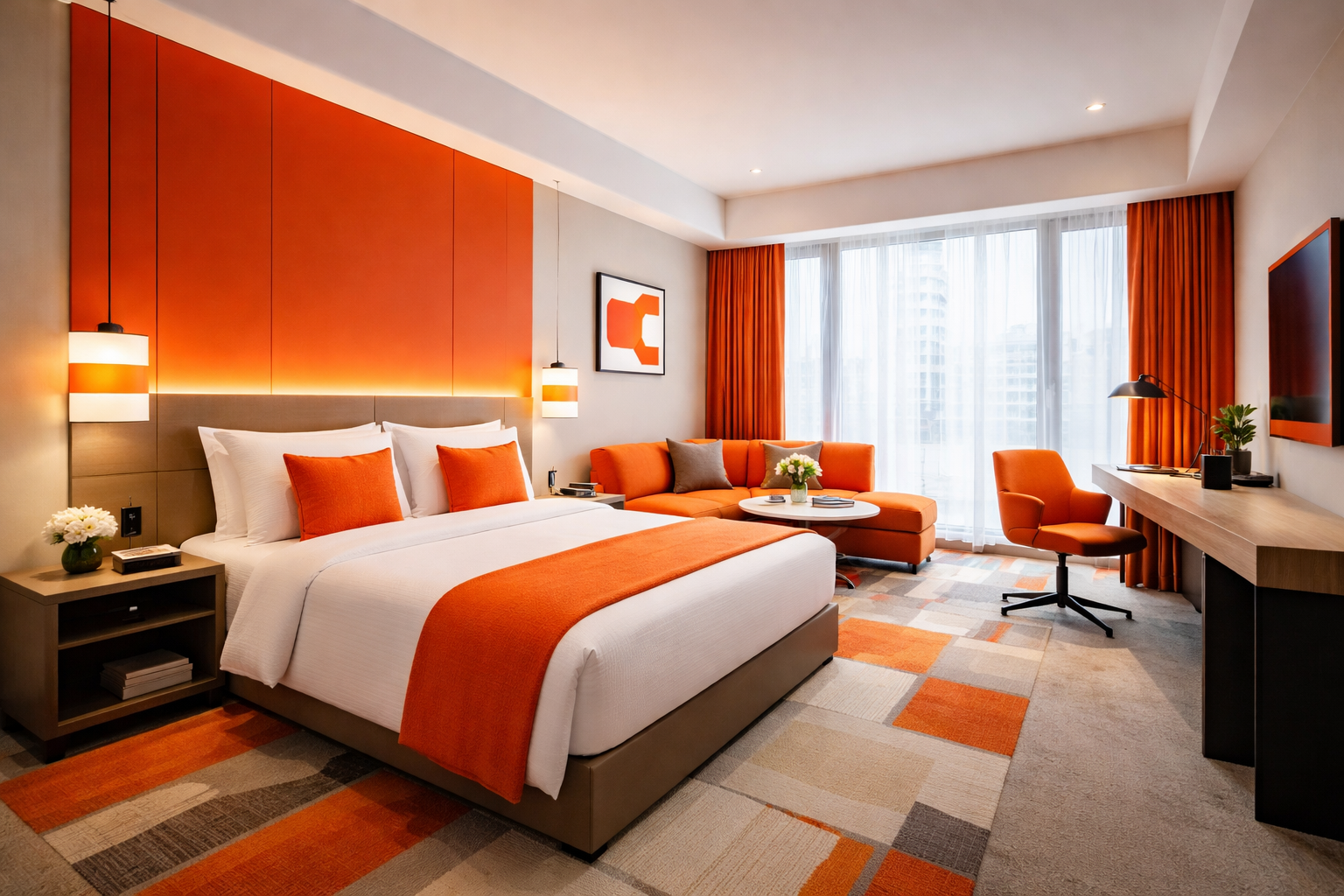
Guest reviews are not random; they are a direct reflection of how a room performs in real-life use. Across hotel audits and guest feedback patterns, the highest-rated rooms are not always the most luxurious, they are the most functional, intuitive, and comfortable.
This guide focuses on practical, experience-backed design decisions that consistently improve guest satisfaction and, in turn, review scores.
1. Provide a Dedicated Work Desk
A work desk is no longer optional. Business and leisure travel have merged, and most guests expect a space where they can sit and work comfortably.
A well-designed desk setup, with adequate lighting, a supportive chair, and accessible power outlets, enhances usability. Rooms that lack this often receive feedback around inconvenience or discomfort, especially from long-stay or business travellers.
2. Install a Full-Length Mirror
A full-length mirror supports everyday guest needs, getting ready for meetings, events, or outings.
Its absence is frequently mentioned in reviews, particularly in mid-scale and premium segments. Including one is a simple way to eliminate a common friction point and improve overall room functionality.
3. Ensure Charging Points on Both Sides of the Bed
Modern guests typically carry multiple devices. Providing charging outlets on both sides of the bed ensures convenience regardless of occupancy.
This small but critical detail improves usability and reflects attention to guest behavior. Hotels that miss this often receive avoidable complaints.
4. Use Blackout Curtains to Improve Sleep Quality
Sleep quality is one of the strongest drivers of positive reviews. Blackout curtains help control external light, particularly in city hotels or properties with early daylight exposure.
Guests who sleep well are significantly more likely to rate their stay positively. This makes blackout curtains a high-impact, cost-effective design element.
5. Include Peepholes and Safety Latches
Basic safety features such as a peephole and door latch are essential. They provide guests with a sense of control and security, especially for solo travellers.
While rarely praised explicitly, their absence can negatively impact trust and comfort, two key factors influencing reviews.
6. Design Layouts That Protect Guest Privacy
Room layout plays a critical role in perceived comfort. Direct visibility of the bed from the main door can feel intrusive.
A better design approach is to introduce a vestibule or entry buffer, ensuring that the bed is not immediately visible when the door opens. This enhances privacy and aligns with guest expectations in well-designed hotels.
7. Use Warm Materials for a Comfortable Ambience
Material selection influences how a room feels. Wooden flooring or carpeting tends to create a warmer, more inviting environment compared to hard, cold surfaces.
Guests may not explicitly identify materials, but they consistently respond to the comfort they provide. This contributes to longer stays, better rest, and improved feedback.
8. Separate Wet and Dry Areas in the Bathroom
A functional bathroom layout improves both hygiene and usability. Separating wet (shower) and dry (sink/toilet) zones prevents water spillage and allows multiple guests to use the space efficiently.
This design detail is commonly associated with higher guest satisfaction, particularly in family and premium segments.
9. Keep Lighting Minimal and Purposeful
Overcomplicated lighting systems often confuse guests. Instead of multiple unnecessary light points, focus on clear, purpose-driven lighting, ambient, task, and bedside.
Well-planned lighting improves usability and creates a more relaxing environment without overwhelming the guest.
10. Minimize and Simplify Switches
Too many switches reduce usability. Guests should be able to control lighting and key functions intuitively.
Clear labeling and a minimal switch layout reduce friction and improve the overall in-room experience, especially for short-stay guests who don’t want to “figure out” the room.
Conclusion
Consistently high guest reviews are not achieved through luxury alone, they come from thoughtful, user-centric design. Each of these elements addresses a specific guest need: comfort, convenience, privacy, safety, and ease of use. When these needs are met seamlessly, guests experience less friction, and that translates directly into better ratings, stronger recommendations, and higher repeat bookings.
In hotel design, it’s not the visible extravagance that drives reviews. It’s the invisible efficiency behind every detail.
Leave a Reply