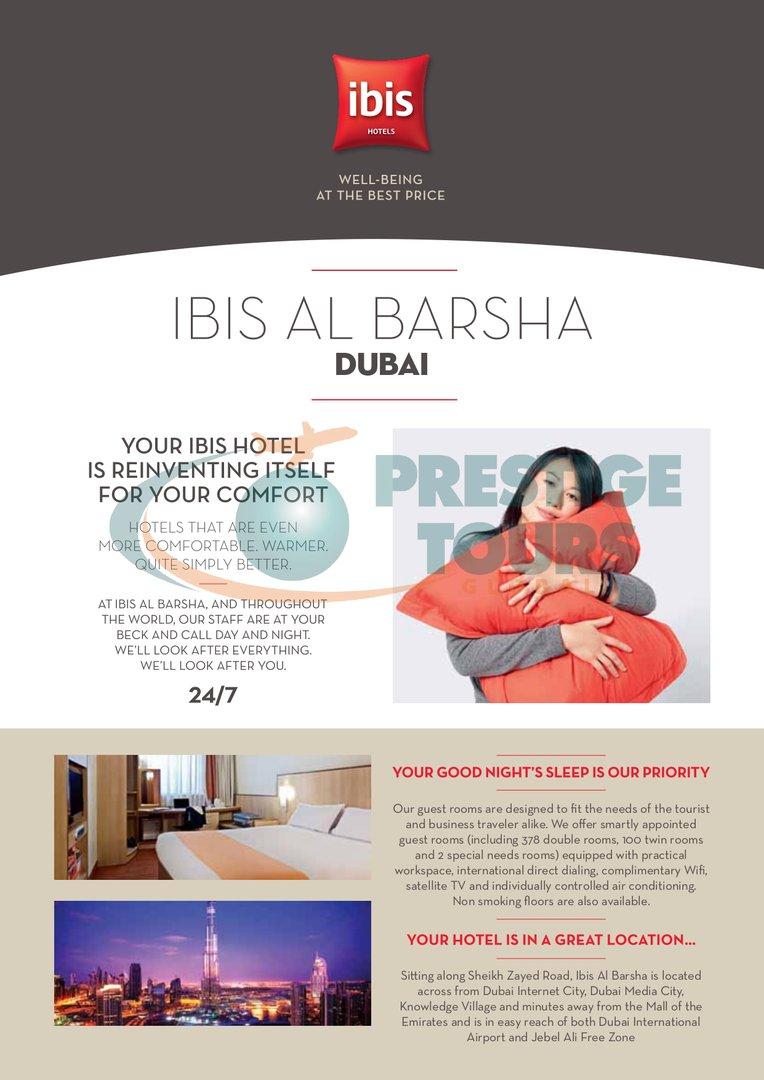
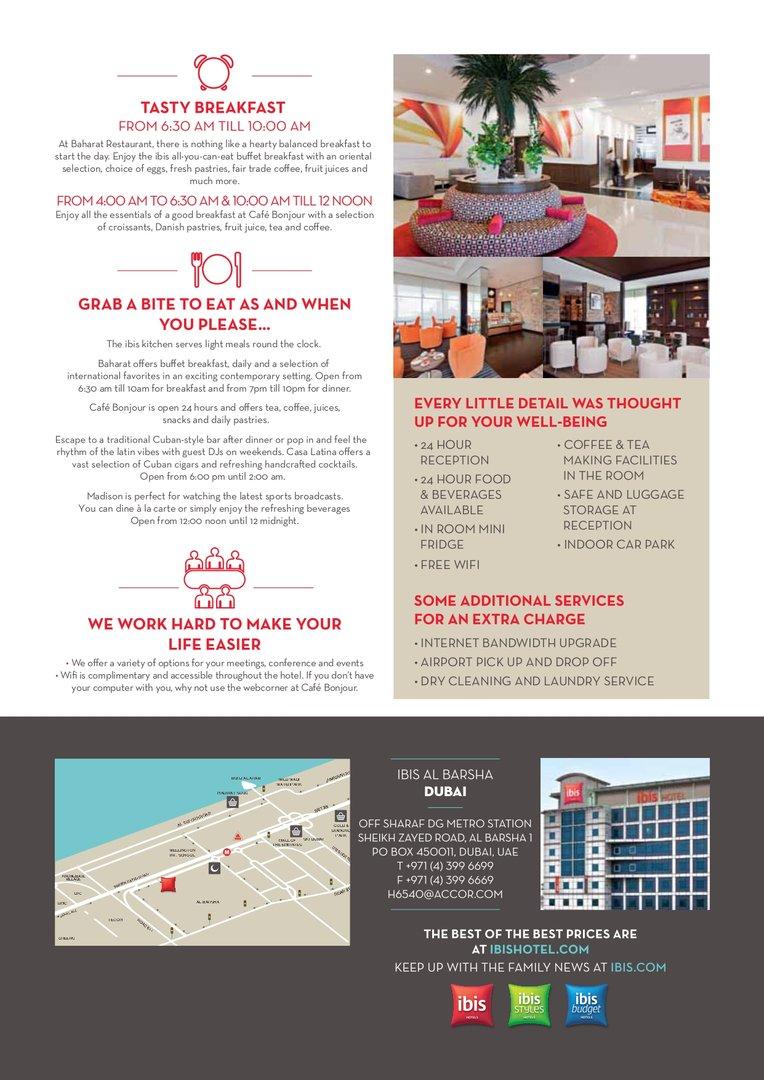
A hotel fact sheet is a very crucial sales collateral, mostly undermined by independent hotels. Hotel fact sheets are used by event planners, group bookers, travel agents, and corporate bookers. This is one tool that gives the bookers all the factual information about the hotel in one shot before they need to make a decision or finalize a venue. If you do not have a fact sheet, the planners may not even bother to call your sales rep and check regarding your facilities or capacity.
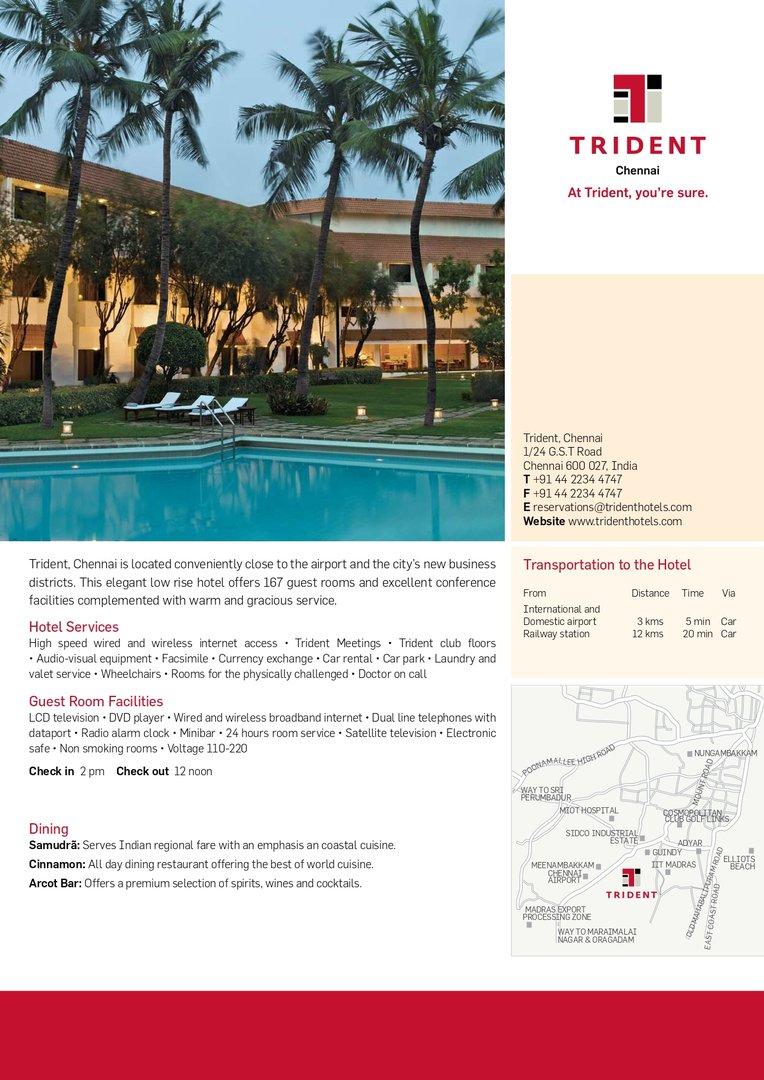
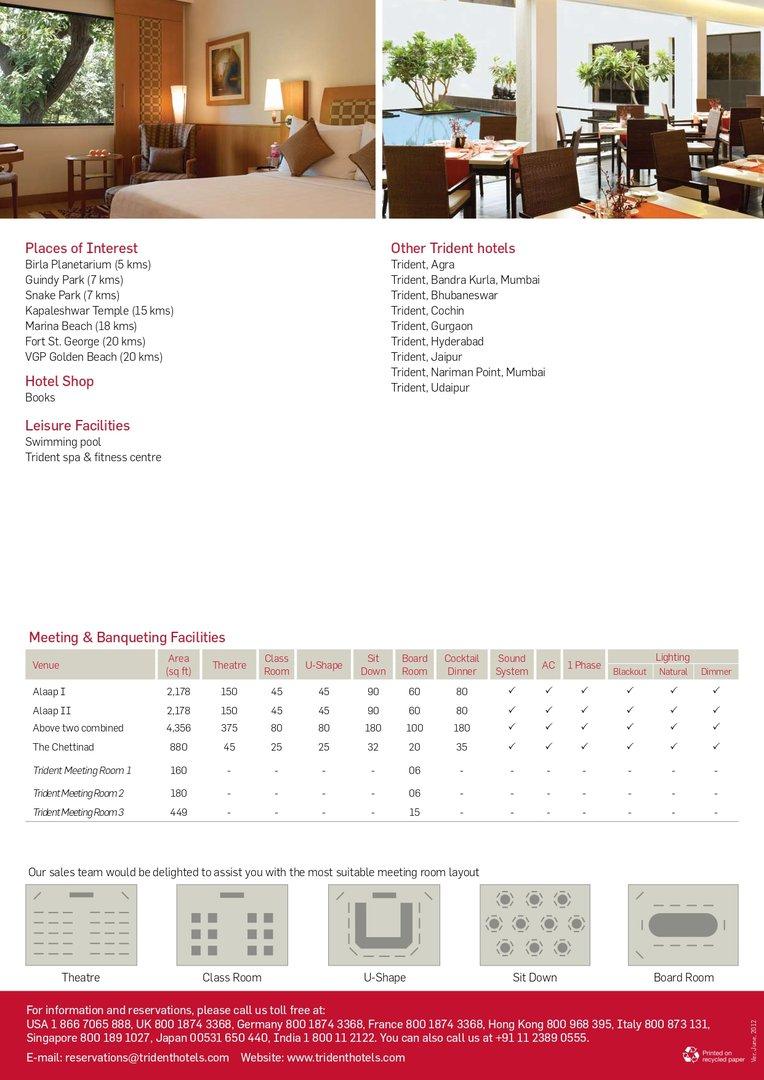
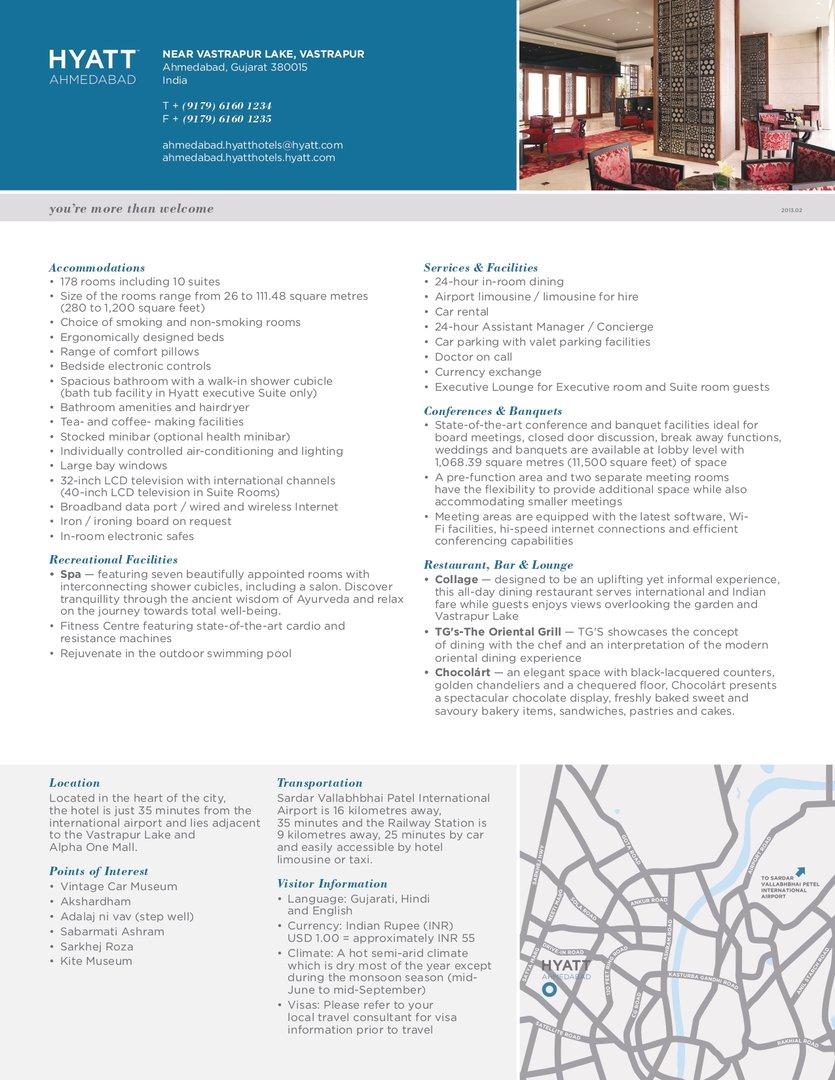
The hotel fact sheet is a simple document that has information such as – property contact details, location, number, size and types of rooms, restaurants, meeting rooms and their capacity, facilities at the hotel, nearby attractions, and so on. You may have all these details on your website, but the bookers consider it a hectic task to navigate your website page by page to find each and every piece of information about the hotel. A hotel fact sheet is also a convenient way for the bookers to share hotel information with their clients or event attendees.
Things to consider for your hotel fact sheet
Design it! Don’t type it out on a word file
We noticed that even some of the popular hotel brands have published fact sheets that were typed in as a word document. Get a professional designer to design the fact sheet for you, do not make the mistake of making your sales collateral bland. Have branding elements on the page and make it look professional and suited for your brand. However, try not to make it too flashy and too colourful.
Two pages are best, three the most
Limit the document to two pages, consider the third page only if you cannot fit essential facts into two pages. Also, when it is two pages, this can be printed on two sides of a single paper, it becomes odd when it is three and becomes difficult to manage when it is even more.
A cover page is not required
A beautifully designed cover page can be a part of your brochure but not required for your fact sheet. This page will only make the document heavier.
Stick to the facts, flowery language does not work
The purpose of a fact sheet is to convey facts and skim through the facts in a few seconds. Nobody is going to read long sentences when they are looking for facts or your story. And so, don’t waste your money paying a copywriter or your time crafting the perfect sentence for each of your facilities.
Readability, Readability, Readability!
Use readable font size and colour. Most hotels try to cramp a lot of unnecessary information and long sentences into the fact sheet. To do this within two pages, they go on reducing the font size and ultimately making it difficult to read. Do not make this mistake. Include only relevant information and use readable font size.
Do not bombard with photographs
Photographs of each facility, room type, meeting room are not required. At the point where someone requires your fact sheet, they would have already known your hotel or have seen the images of your hotel or trust that the rooms are going to be good. Including photographs of every room type or facility is only going to cramp your hotel fact sheet. So add only necessary photographs and that too if you have ample space in the fact sheet. A detailed beautifully designed brochure with a cover page, images of the room, stories can always be a separate document.
Size of the PDF document matters
Make sure that the file size of your hotel fact sheet’s PDF copy is not more than 2 to 3 MB. When you include more images into the fact sheet, it becomes heavy and makes it difficult to share over WhatsApp, email, or any other means.
Download link in email signatures
Rather than attaching the fact sheet every time your reservation or sales employee sends out an email, have a link to download the document in their signature.
Download link on hotel website
Make a PDF copy of your fact sheet available to download on your hotel’s website. A new potential booker mostly lands on your website to check the details of your hotel. If a fact sheet is readily available to him/her, it makes their life so much easier.
Hotel fact sheet samples – the ones we loved the most
We evaluated hundreds of hotel fact sheets before writing this article, and these three are the ones we loved the most.
This article will introduce you to Buzil Rossari Housekeeping Chemicals and assist you in understanding the specific Diversey alternatives if you decide to switch. While Diversey is an extremely good brand with a proven track record of consistency and performance, we believe Buzil is the next best alternative if you are cost conscious and want to keep your hotel affordable to your customers.
Whether your hotel is small, medium, or large, the cost of cleaning chemicals, after guest amenities and linens, is a major consideration. Despite the fact that many Indian cleaning chemical brands have emerged in recent years, the majority of hotels continue to use Diversey. Even when these Desi brands are 30% to 50% less expensive than Diversey.
Diversey has been able to maintain their market share over the years, despite being expensive, due to their impeccable consistency in the product and their continuous training programme for housekeepers. Due to the difficulty in persuading customers about their R&D processes and consistency, no Indian brands have been able to compete with Diversey in terms of market share.
Because Diversey products are so expensive, our customers have been asking us for a dependable alternative. We had never been able to provide an alternative until last year.
Buzil-Rossari
Buzil-Rossari is a joint venture between Rossari Biotech Limited (a publicly traded Indian chemicals company) and BUZIL-WERK Wagner GmbH & Co. KG (a German cleaning chemicals leader). Rossari Biotech intends to disrupt the Indian cleaning chemical market with low-cost, high-quality cleaning solutions in hospitality, healthcare, facility management, laundry, disinfection, personal hygiene, and special care products. This collaboration is supported by Buzil’s 100-year success story in Germany and other European countries, as well as Rossari Biotech’s excellent manufacturing, quality assurance, and supply chain capabilities.
Buzil Rossari Housekeeping Chemicals, an Alternative to Diversey Cleaning Chemicals
Here is a list of commonly used Diversey products and their Buzil Rossari Housekeeping Chemicals alternatives to consider:
Diversey Products and Their Buzil Rossari Counterpart
Application
Diversey Product
Buzil Alternative
Bathroom Cleaner
Diversey TASKI R1 Super
B1 BUCAL G 468
General Purpose Cleaner
Diversey TASKI R2
B2 ROS FCH
Glass Cleaner
Diversey TASKI R3
B3 RS GC
Furniture Polish
Diversey TASKI R4
B4 Buz Finesse
Air Freshener
Diversey TASKI R5
B5 BUZ RO Fresh Lavender, B5 BUZ RO Fresh Mahogany
Toilet Bowl Cleaner
Diversey TASKI R6
B6 ROSS TCE
Floor Cleaner Concentrate
Diversey TASKI R7
B7 BUZ RO Fresh Citral, ROSS HDC
Diversey vs Buzil Rossari pH Comparison Chart
Application
Diversey
Buzil-Rossari
Bathroom Cleaner
9.5 – 11.0
9.5 – 11.0
General Purpose Cleaner
9.5 – 11.0
9.5 – 11.0
Glass Cleaner
6.5 – 7.5
6.5 – 7.0
Furniture Polish
6.5 – 7.5
7.5 – 8.0
Air Freshener
6.5 – 7.5
6.5 – 7.5
Toilet Bowl Cleaner
≤ 2.0
0.5
Floor Cleaner Concentrate
8.5 – 9.5
12.0 – 14.0
Diversey vs Buzil Rossari Dilution Comparison Chart
Application
Diversey
Buzil-Rossari
Bathroom Cleaner
20 ml in 1 litre of water
10 ml in 1 litre of water
General Purpose Cleaner
20 – 40 ml in 1 litre of water
20 ml in 1 litre of water
Glass Cleaner
20 – 50 ml in 1 litre of water
20 – 50 ml in 1 litre of water
Furniture Polish
Ready-to-use
Ready-to-use
Air Freshener
Ready-to-use
Ready-to-use
Toilet Bowl Cleaner
Ready-to-use
Ready-to-use
Floor Cleaner Concentrate
20 – 50 ml in 1 litre of water
10 – 15 ml in 1 litre of water
Diversey vs Buzil Rossari Effective Price Per Litre
If you’re a hotelier, one of your top priorities is making sure that guests have a comfortable stay and your property remains utmost hygienic.
Diversey (formerly: Johnson Diversey) products are designed to keep surfaces clean without compromising the natural feel or look of your property – so they can help maintain that luxury vibe while still being environmentally friendly. In India, Diversey products list is an exhaustive one with over 170 cleaning chemicals for various specialised applications. These cleaning chemicals are classified by Diversey into various other sub-brands:
TASKI – Cleaning used in housekeeping.
SUMA – Chemicals used in kitchen and food service departments.
CLAX – Chemicals used in commercial laundry.
Softcare – Personal care products like hand wash and sanitisers.
Here we discuss the most popular TASKI chemicals list and uses every housekeeping professional should be thorough of.
TASKI Cleaning Product Table
Product
Application
Pack Size
Normal Soiling
Heavy Soiling
TASKI R1
Bathroom cleaner
5 Litre
20 ml in 1-litre water
20 ml in 1-litre water
TASKI R2
General-purpose hard surface cleaner
5 Litre
20 ml in 1-litre water
40 ml in 1-litre water
TASKI R3
Glass cleaner
5 Litre
20 ml in 1-litre water
50 ml in 1-litre water
TASKI R4
Furniture maintainer
5 Litre
Ready-to-use
Ready-to-use
TASKI R5
Air freshener
5 Litre
Ready-to-use
Ready-to-use
TASKI R6
Toilet bowl cleaner
5 Litre
Ready-to-use
Ready-to-use
TASKI R7
Floor cleaner
5 Litre
20 ml in 1-litre water
50 ml in 1-litre water
TASKI R9
Bathroom cleaner for hard water locations
5 Litre
50 ml in 1-litre water
100 ml in 1-litre water
TASKI Spiral HD
Heavy-duty floor cleaner and degreaser
5 Litre
20 ml in 1-litre water
50 ml in 1-litre water
TASKI Metal Polish
All-purpose metal polish
100 ml / 200 ml
Ready-to-use
Ready-to-use
TASKI Green Apple
Air freshener
5 Litre
Ready-to-use
Ready-to-use
TASKI R1 Super – bathroom cleaner-cum-sanitiser concentrate
TASKI R1 Super is a cleaning and disinfectant agent that is formulated completely to clean and disinfect all surfaces in the bathroom, namely sinks, bathtubs, tiles, floors, and fixtures. This delightfully scented product contains no abrasives or bleach. TASKI R1 is safe for bathroom furniture, marble, and granite.
TASKI R2 – general purpose hard surface cleaner concentrate
TASKI R2 is a concentrated cleaning agent with a universal disinfectant. This pleasantly scented product without abrasives or bleach is ideal for quickly and gently cleaning all hard surfaces (e.g. TV cabinets, photo frames, phones, etc.), including glass and mirrors. TASKI R2 is recommended for use on glossy floor surfaces such as polished marble, granite, etc.
TASKI R3 – glass cleaner concentrate
TASKI R3 is a concentrated cleaning agent for cleaning all types of glass and mirrors. Regular cleaning of windows, panes and mirrors with the TASKI R3 keeps surfaces clean and streak-free.
TASKI R4 Shine-up – furniture maintainer
TASKI R4 Shine-up is a product for the treatment of wooden furniture. With daily use, it cleans and leaves a deep, shiny shine on wooden furniture.
TASKI R5 – air freshener
TASKI R5 is a water-based air freshener with a pleasant floral scent that deodorizes guest rooms, banquet halls and offices. This product is extremely economical in use, when compared with aerosol-based air fresheners and does not use ozone-depleting aerosols.
TASKI R6 – toilet bowl cleaner
TASKI R6 is an effective toilet cleaner specially formulated to remove scale and stubborn stains. Leaves the toilet bowls and urinals shiny and clean. Regular use of TASKI R6 prevents lime-scale build-up.
TASKI R7 – floor cleaner concentrate
TASKI R7 is an effective floor cleaner. It can be used for wet mopping and machine cleaning.
TASKI R9 – bathroom cleaner concentrate for hard water locations
TASKI R9 is a cleaner that is fully formulated to clean all fixtures and walls in the bathroom, viz. Sink, tub, tiles and faucet. It was developed specifically for use in hard water regions. Regular use of TASKI R9 prevents limescale deposits on walls and fixtures.
TASKI Spiral HD – heavy duty floor cleaner and degreaser
Strong alkaline industrial degreaser for effective removal of mineral/synthetic oil, tar, grease, soot, etc. TASKI Spiral HD is mainly used to remove dirt from very dirty floors. It can also be used for low and medium soil conditions at lower concentrations.
TASKI Metal Polish – all purpose metal polish
TASKI Metal Polish is a universal cleaning agent for cleaning and polishing metal together. Cleans and brightens dull surfaces by removing dirt, rust, water stains, chalk, chalk, heat discoloration, lead and dust residue, oxidation, insects, tar, oil, fingerprints, wood resin, bird droppings, bird droppings, bird droppings and stains. It deposits afterwards a fine coat of wax to provide intense lustre restoring the original sheen which protects it further against scratches and oxidation.
TASKI Green Apple – liquid odor counteractant
TASKI Green Apple is a water-based air freshener with a pleasant Green Apple scent that deodorizes guest rooms, banquet halls and offices.
What is R1 to R9 in Housekeeping?
Most cleaning chemical manufacturers use this list as a starting point and create their own series for the same applications. They even copy the R1, R2, R3 and so on naming series to their own P1, P2, P3, P4 or M1, M2, M3, M4 and so on range. As a result, it is common for housekeeping professionals to regard this as the primary reference for housekeeping chemical list.
We hope this article provided a good overview of the basic Diversey TASKI products list needed to keep your hotel, resort or any other commercial building clean and sanitary. The list is not all-inclusive and it’s important that you add appropriate chemical products for each special situation that may arise.
If you’re a hotelier, one of your top priorities is making sure that guests have a comfortable stay and your property remains utmost hygienic.
Diversey (formerly: Johnson Diversey) products are designed to keep surfaces clean without compromising the natural feel or look of your property – so they can help maintain that luxury vibe while still being environmentally friendly. In India, Diversey products list is an exhaustive one with over 170 cleaning chemicals for various specialised applications. These cleaning chemicals are classified by Diversey into various other sub-brands:
TASKI – Cleaning used in housekeeping.
SUMA – Chemicals used in kitchen and food service departments.
CLAX – Chemicals used in commercial laundry.
Softcare – Personal care products like hand wash and sanitisers.
Here we discuss the most popular TASKI chemicals list and uses every housekeeping professional should be thorough of.
TASKI Cleaning Product Table
Product
Application
Pack Size
Normal Soiling
Heavy Soiling
TASKI R1
Bathroom cleaner
5 Litre
20 ml in 1-litre water
20 ml in 1-litre water
TASKI R2
General-purpose hard surface cleaner
5 Litre
20 ml in 1-litre water
40 ml in 1-litre water
TASKI R3
Glass cleaner
5 Litre
20 ml in 1-litre water
50 ml in 1-litre water
TASKI R4
Furniture maintainer
5 Litre
Ready-to-use
Ready-to-use
TASKI R5
Air freshener
5 Litre
Ready-to-use
Ready-to-use
TASKI R6
Toilet bowl cleaner
5 Litre
Ready-to-use
Ready-to-use
TASKI R7
Floor cleaner
5 Litre
20 ml in 1-litre water
50 ml in 1-litre water
TASKI R9
Bathroom cleaner for hard water locations
5 Litre
50 ml in 1-litre water
100 ml in 1-litre water
TASKI Spiral HD
Heavy-duty floor cleaner and degreaser
5 Litre
20 ml in 1-litre water
50 ml in 1-litre water
TASKI Metal Polish
All-purpose metal polish
100 ml / 200 ml
Ready-to-use
Ready-to-use
TASKI Green Apple
Air freshener
5 Litre
Ready-to-use
Ready-to-use
TASKI R1 Super – bathroom cleaner-cum-sanitiser concentrate
TASKI R1 Super is a cleaning and disinfectant agent that is formulated completely to clean and disinfect all surfaces in the bathroom, namely sinks, bathtubs, tiles, floors, and fixtures. This delightfully scented product contains no abrasives or bleach. TASKI R1 is safe for bathroom furniture, marble, and granite.
TASKI R2 – general purpose hard surface cleaner concentrate
TASKI R2 is a concentrated cleaning agent with a universal disinfectant. This pleasantly scented product without abrasives or bleach is ideal for quickly and gently cleaning all hard surfaces (e.g. TV cabinets, photo frames, phones, etc.), including glass and mirrors. TASKI R2 is recommended for use on glossy floor surfaces such as polished marble, granite, etc.
TASKI R3 – glass cleaner concentrate
TASKI R3 is a concentrated cleaning agent for cleaning all types of glass and mirrors. Regular cleaning of windows, panes and mirrors with the TASKI R3 keeps surfaces clean and streak-free.
TASKI R4 Shine-up – furniture maintainer
TASKI R4 Shine-up is a product for the treatment of wooden furniture. With daily use, it cleans and leaves a deep, shiny shine on wooden furniture.
TASKI R5 – air freshener
TASKI R5 is a water-based air freshener with a pleasant floral scent that deodorizes guest rooms, banquet halls and offices. This product is extremely economical in use, when compared with aerosol-based air fresheners and does not use ozone-depleting aerosols.
TASKI R6 – toilet bowl cleaner
TASKI R6 is an effective toilet cleaner specially formulated to remove scale and stubborn stains. Leaves the toilet bowls and urinals shiny and clean. Regular use of TASKI R6 prevents lime-scale build-up.
TASKI R7 – floor cleaner concentrate
TASKI R7 is an effective floor cleaner. It can be used for wet mopping and machine cleaning.
TASKI R9 – bathroom cleaner concentrate for hard water locations
TASKI R9 is a cleaner that is fully formulated to clean all fixtures and walls in the bathroom, viz. Sink, tub, tiles and faucet. It was developed specifically for use in hard water regions. Regular use of TASKI R9 prevents limescale deposits on walls and fixtures.
TASKI Spiral HD – heavy duty floor cleaner and degreaser
Strong alkaline industrial degreaser for effective removal of mineral/synthetic oil, tar, grease, soot, etc. TASKI Spiral HD is mainly used to remove dirt from very dirty floors. It can also be used for low and medium soil conditions at lower concentrations.
TASKI Metal Polish – all purpose metal polish
TASKI Metal Polish is a universal cleaning agent for cleaning and polishing metal together. Cleans and brightens dull surfaces by removing dirt, rust, water stains, chalk, chalk, heat discoloration, lead and dust residue, oxidation, insects, tar, oil, fingerprints, wood resin, bird droppings, bird droppings, bird droppings and stains. It deposits afterwards a fine coat of wax to provide intense lustre restoring the original sheen which protects it further against scratches and oxidation.
TASKI Green Apple – liquid odor counteractant
TASKI Green Apple is a water-based air freshener with a pleasant Green Apple scent that deodorizes guest rooms, banquet halls and offices.
What is R1 to R9 in Housekeeping?
Most cleaning chemical manufacturers use this list as a starting point and create their own series for the same applications. They even copy the R1, R2, R3 and so on naming series to their own P1, P2, P3, P4 or M1, M2, M3, M4 and so on range. As a result, it is common for housekeeping professionals to regard this as the primary reference for housekeeping chemical list.
We hope this article provided a good overview of the basic Diversey TASKI products list needed to keep your hotel, resort or any other commercial building clean and sanitary. The list is not all-inclusive and it’s important that you add appropriate chemical products for each special situation that may arise.
Hotel amenities can be a great marketing tool for your hotel, so you need to consider carefully which amenities to provide. You will be able to pique the interest of potential guests by offering the right amenities, based on your target segment.
Here are some of the best hotel amenities and facilities that you should consider including in your hotel in order to compete with chain hotels and win business travellers.
Work
Work Desk
Most independent business hotels have work desks as part of their hotel amenities, but they are mostly name-sake workstations with no access to power outlets, lamps, or even a proper ergonomic work chair. In business hotels, the work desk is just as important as the bed. People who travel for work have long nights preparing presentations, emails to respond to, and spreadsheets to analyse. When your workstation is not comfortable, it can be very frustrating.
Work Stations in Common Areas
Aside from having enough desk space in their room, business travellers can benefit greatly from staying in a hotel with alternative workspaces. Boutique hotel brands are increasingly providing co-working spaces within their walls to ensure business guests have a dedicated area to tackle tasks and network during their stay. However, even an onsite coffee shop or lounge with enough power outlets to hunker down and answer emails can provide much-needed relief. Getting away from client meetings and hotel rooms can help business travellers re-energize and feel more inspired to tackle their inbox or prepare for that big pitch.
Private Meetings Spaces
Chain hotels offer private meeting spaces that include all the amenities of a conference room. These spaces can be reserved for as little as an hour, and most hotels will waive the room fee if you order food or drinks from their restaurant or bar. This option is ideal for last-minute meetings, interviews, or client pitches when you don’t have access to a conference room. This is a great convenience for business travellers.
Allow Visitors
Many hotels do not allow visitors into guest rooms or public areas, citing security concerns. This is perfectly acceptable and at the discretion of management. However, from the perspective of a businessperson, meetings and networking are unavoidable. In such a case, denying visitors access to rooms will be a disappointment to your guests. When you have an entire room, it is inconvenient to go down to the lobby or the coffee shop to meet someone. Meeting privacy also irritates your guests. If the management is concerned about security, the solution is not to deny guests access to rooms, but rather to implement proper check procedures.
Technology
Free High-speed Wireless Internet
Wi-Fi is one of the most important among hotel amenities for business travellers. It is no longer sufficient to provide ‘good Wi-Fi.’ Wi-Fi today should be unmetered and unrestricted, with unlimited devices and features such as roaming. Invest in high-quality wireless internet technology as well as a high-bandwidth leased line. This is a significant investment, but it should never be subsidised or replaced with a cheaper alternative. Your business guests will not return if your internet is poor.
Wireless Printer at the Business Centre
Business travellers find it necessary to print documents while while travelling, it could be their travel documents or for a meeting. In this case, it might be helpful for your guests to know there’s a wireless printer they can use at the hotel business centre. Wireless printers are able to quickly connect to devices without installation of any software or cables. It can also help guests print directly from their mobile phones.
Bed Side Power Outlets with Latest USB Port
It is simply convenient to have power outlets close to the bed. At the design stage, some hotels prioritise aesthetics over functionality. It is critical for business people to charge their phones and iPads close to where they sleep. Their alarm is critical to them, and they can expect a call at any time of day. Some of them enjoy waking up and checking their emails on their phones while still in bed.
Mobile Phone Charger on Demand
Always keep one or two chargers for each phone type on hand at the front desk. It is quite common for people to leave their chargers at home.
Wireless Charges Built into the Side Table
This is merely a marketing ploy, but business travellers would appreciate it. Purchase high-quality wireless charging modules that can be built into bedside tables.
Bluetooth Speakers with a Clock
With the advent of mobile phones, alarm clocks are becoming obsolete in hotel rooms. In upscale hotels, the alarm clock has been replaced with a more feature-rich device that includes Bluetooth speakers, a mobile charging dock, and a clock. While working, business travellers would benefit from listening to light music or their favourite podcasts.
Laptop Compatible Safety Locker
A laptop safe box is similar to any other digital safety locker, except that it is large enough to accommodate a laptop. When the guest leaves for work, he would want his laptop, among other valuables, to be safe. An electronic safe locker is a common hotel amenities, if you are refurbishing your hotel, consider upgrading to laptop safe box.
Grooming
Shaving Kit
A standard among hotel amenities in most properties, whether they are business hotels or vacation resorts. However, in some properties, this is an on-demand item. If you own a business hotel, do not make this an on-demand item. Provide the guests with a shaving kit so they can shave their beards before their most important meeting.
Shaving Mirror
In order to save money, independent hotels forego the function of a shaving mirror in favour of a larger mirror in the bathroom. To get a closer shave, business travellers are accustomed to the luxury of shaving mirrors in chain hotels. To remain competitive, make sure you offer on in your restrooms as well. Some guests are very particular about these minor details.
Shaver Power Point
Some guests bring their own shavers. It is critical to have a shaver power point close to the shaving mirror. It is merely a functional feature.
Hair Dryer
Both men and women use hair dryers to not just drying their hair, also to set their hair before their head for a meeting. It is mostly popular with women, so if you want to impress business women, this is a must-have. For most properties this is a part of on-request hotel amenities, but if you have them pre-installed in every room, you will have a definite advantage over your competitors among female business travellers.
Iron and Ironing Board
Business people are always concerned with their appearance and personality. They would never want to appear shabby in wrinkled clothes to a meeting. Don’t make them call housekeeping first thing in the morning to request an ironing board. And if your stock of ironing boards has already been distributed to rooms, guests will have to wait for someone to finish using it before they can use it. Waiting for the iron board is a complete waste of time for the guest. It is one of the standard hotel amenities provided by chain hotels. Don’t create a chaos for your guests, just put one of those in each of your rooms.
Shoe Shine Sponge
The sponges, which are usually about the size of a bar of soap, allow guests to quickly and easily polish their shoes without having to go out and find a shoe shine service.
Shoe Shine Machine in the Lobby
The shoe shine machine in the hotel lobby is a hotel amenity that offers a convenient and quick way for guests to have their shoes polished while they are staying at the hotel. The machine is easy to use – a rotating brush in the machine buffs the shoes to a high shine. This shoe shine machine is a great addition to the hotel lobby because it provides guests with a quick, easy, and affordable way to polish their shoes before their meeting.
Express Laundry Service
Business travellers can be a finicky bunch when it comes to laundry. They want their shirts and trousers looking pristine, and they want everything delivered on time. It’s difficult to do that without express laundry services. Whether you’re working out of the hotel for a week or just need your shirts pressed in a hurry before business meetings, there is an express laundry service for you.
Hygiene
Sanitary Disposal Bag
According to a recent study, the most important of hotel amenities for a business woman when choosing a hotel is hygiene and cleanliness. If you own a hotel and want to impress businesswomen, make sure to provide a sanitary disposal bag. Your female guests will appreciate the extra care taken with sanitation.
Coloured Bath Towels
It is quite common for business travellers to share rooms among colleagues. Provide different colour towel sets upon request for those who do not want their towels mixed up. Most of the time, the hotel front desk and housekeeping are already aware that the guest is travelling for business and that they are colleagues; in such cases, place coloured towels even before their check-in.
Twin Rooms
While sharing a room with colleagues, business travellers would prefer a twin room with two separate beds. Consider allocating a set of rooms with two separate beds or a convertible bedding option in which the twin bed can be converted to a full size bed.
Shoe Cover
Keep a shoe cover with your hotel logo imprinted in your guest closet. Everyone would want to keep their shoes separate from their clothes in their luggage. The best part is that you can be confident that your guest will use this shoe cover for a long time. Most hotels do not provide shoe covers in guest rooms because they consider them to be an unnecessary guest supply. However, separating a dirty shoe from other closes is unavoidable for anyone, so if a shoe cover is not found in the room, they will either use a plastic cover or one of your laundry bags to do the job. A laundry bag costs you much more than a shoe cover.
Coat Hanger
You could either provide proper coat hangers in the closet or a coat stand for your guests to hang their blazers and coats.
Food & Dining
Early Breakfast
The majority of business people are early risers. They must leave their cosy beds very early in the mornings to travel to the airport or to a meeting. As a result, for those who frequently travel for business, it is critical to stay in a hotel that can make their lives easier. Those who have an early flight or a meeting to attend should eat breakfast as soon as possible and get ready for their day. Chain hotels, such as ibis, offer an early breakfast option that begins at 4 a.m. The menu does not have to be a full breakfast spread; a simple breakfast menu will suffice.
Breakfast To-Go
When travelling for business, it’s not always possible to eat breakfast before heading out to a meeting or boarding a flight. You should be concerned about your guests’ health and provide a breakfast option that they can eat on the go.
Private Dining Rooms (PDR)
Many restaurants and hotels have private spaces within their restaurants that allow you to dine privately from the rest of the restaurant, with only the guests you have invited. This can be an interesting add-on for businessmen.
In-room Tea and Coffee
This is among the standard hotel amenities in any property, big or small. It is common for people in business to drink a lot of coffee, usually while working or attending meetings. For many, it is the caffeine that keeps them going energetically throughout the day or night. Make sure to provide the best brands of coffees and teas in the room, as well as a coffee maker or a tea kettle. You could also provide speciality teas such as green tea and Earl Grey.
Convenience
Hotel amenities can be a great marketing tool for your hotel, so you need to consider carefully which amenities to provide.
Wake Up Call Service
People have used this service less since the introduction of mobile phones. However, if your guests have a flight to catch or an important business meeting, they will choose it because they do not want to risk not waking up after hitting the snooz button on their mobile alarm. The service is provided either manually or automatically, with the wake-up call time being entered into the PBX system and the system automatically calling the guest room at the predetermined time. It can also be managed manually by front-desk staff. Whether or not the guest uses the service, it would be nice to check with them while they check-in.
Writing Pen and Notepad
It may seem like a small thing, but when need to take down a phone number or make a reservation, or scribble some notes while you work, it’s really nice to have those items available. It is one of the most basic hotel amenities.
Laptop on Demand
Keep one good laptop with the most recent operating system and office applications installed at the front desk for guests to use if their laptop malfunctions or breaks down. This is a once-in-a-lifetime possibility, and your guests will be grateful. You may not need to keep a spare laptop on hand, but even offering one of the manager’s laptops for the time being will be greatly appreciated by your guests.
AMEX Card Acceptance
Many corporations now have an American Express Business Travel Account (BTA), which makes managing business travel expenses simpler and more cost-effective. The system assists corporate companies with simple reconciliation, comprehensive travel data, consolidating business travel expense data, and providing a single bill and payment for all corporate travel costs, thereby streamlining and centralising operations. As a result, accepting AMEX cards is a must if you want top-tier business travellers to consider staying at your hotel. Executives of companies that use BTA have no other way to pay you, so if you don’t have the facility, you simply do not get their business.
Complimentary Airport and Railway Station Transfers
One of the most frequently asked questions on tripadvisor.com is, “Do you do airport pickup and drop off?” Business travellers will appreciate the hotel’s airport or railway station pickup and drop-off service. This saves the hotel guest from having to wait for a taxi or go through the time-consuming process of renting a car. Furthermore, guests prefer a hotel-arranged transfer to a rented cab because it is more comfortable and secure. They also don’t have to deal with directing cab drivers to the hotel, who are mostly fluent in the local language.
Business Suite
If you are constructing a new hotel or renovating an existing one, consider allocating a few rooms in the category of Business Suites, which include a separate living room where your guest can conduct meetings, a better work desk, and other hotel amenities that a business traveller would prefer.
Flexible Check-in and Check-out
Business travellers’ schedules are dictated by their flight times, and because they are busy people, they have no intention of wasting their valuable time at your hotel unless they are on vacation. Provide your corporate travellers with convenient early check-ins and late check-outs. Furthermore, you will have an advantage over your competitors if you can provide 24-hour check-in and check-out exclusively for guests travelling on official business trips.
Car Wash on Demand
Offer a service that allows business travellers to get their car washed without having to leave the hotel premises. You can partner with any nearby door-step car wash company and all you need to do is call or book the service, and a team of professionals will come to the hotel and take care of everything. You can also get one of your drivers or housekeeping employees clean the car for your guest. If the guest brings in a car, check with the guest if the’d like their car washed in the morning. It is up to the hotel to provide it free or chargeable. If the service is done by one of your employees on duty, try and offer it free of cost as a gesture to the guest.
Daily Newspaper and Business Magazines
Business people are the ones who want to be kept up to date on what is going on. Provide daily newspapers to rooms and a large selection of current business magazines in the lobby.
Free Water Bottles and Newspaper To-Go
Allow your front desk to offer a compact bottle of water to keep your guest hydrated before his meeting and a newspaper to read while travelling, when he is leaving for a meeting or checking out. If they are on their way to a meeting, wish them good luck.
Coffee Table with Comfy Couches
If you own a business hotel, coffee tables are among the essential hotel amenities for your guests. There is more to it than just having coffee. This is where guests would like to unwind after a long day. If you have a coffee table, your guests can have small discussions with visitors. They would use it to loosen up and read the newspaper in the morning. They could also use it as an alternative place to sit if they get tired of sitting at their work desk for long periods of time.
Flexible Cancellation Policy
Last-minute cancellations are common in business travel. Provide your corporate travellers with an exclusive free last-minute cancellation service. This will only increase your customer’s loyalty.
Dedicated Account Manager
People in business generally dislike wasting time opening a website to book a flight or sending an email to make a hotel reservation. Ensure that whenever your hotel receives a corporate booking, it is assigned to an account manager and that the account manager meets the guest. The guest should then be able to book your hotel through a phone call or a simple WhatsApp message. The account manager should handle the rest. This convenience will ensure that the guest returns to your hotel on every trip to the city. Unless you make a mistake, he will never look for another hotel.
Hotel amenities are important to many people, especially those who like their creature comforts. A hotel’s amenities can make or break a stay. Hotels that offer amazing amenities have the potential to stand out from the rest of the competition.
We attempted to include as many hotel amenities as business travellers requested. If you have any creative hotel amenities a business hotel could offer , please leave them in the comments section below.
Zarnik is India’s leading luxury hotel amenities suppliers; contact us to learn how we can assist you in sourcing the luxury hotel amenities list your hotel requires to meet the needs of business travellers.
Restaurants have a variety of paper napkin options to choose from, each with its own benefits and drawbacks. Generally, the most popular option is tissue paper, which is thin and absorbent. However, it can sometimes be too delicate for certain tasks, such as when trying to clean up a spilled drink. In those cases, a more durable option like construction paper might be a better choice. It’s important to consider the needs of your business when selecting tissue napkins, as well as the type of clientele you cater to. In this blog post, we’ll explore the different types of paper napkins and discuss when each type is best used. We’ll also provide tips on how to select the right type of table napkin for your restaurant.
Advantages of using Paper Napkins over Cloth Napkins
New and hygienic every time
Inexpensive and easily available
Bio-degradable and most eco-friendly
Operationally convenient and multipurpose
Choosing the right Paper Napkin: Things to consider
Type of restaurant – Is your restaurant a QSR, casual dining, fine dining, café, or takeaway? The first deciding factor while choosing a paper napkin should always be ‘What type of restaurant is it?’. This will define the type of customers that come into your restaurant and their expectations.
Traffic – Do you have a high, medium, or low table turn rate? If you have high traffic in your restaurant then expensive tissue napkins might become a major expense item on your P&L. On the other hand, if your restaurant is a place with medium traffic and is a place where people relax, discuss and spend time while having their meal, then you should opt for a medium-quality paper napkin.
Menu – Do you serve buffet, al-a-carte, or quick snacks. If you serve a buffet, then your customers are going to need something to clean up more often, in such a case, opt for high quality, highly absorbent, and a large paper napkin.
Average Per Cover (APC) – If you have a very low APC, it doesn’t make sense to spend too much on a customer just for tissue napkins. Ultimately everything boils down to money.
Popular Types and Sizes of Paper Napkins
Name
Size in Inch
Size in Cm
Ply
Restaurant Type
Napkins Per Guest
Beverage Napkin
10 x 10
25 x 25
1 Ply
Bar, Café
3 to 5 per guest
Snack Napkin
12 x 12
30 x 30
1 Ply
Takeaway, Quick-service
2 to 3 per guest
Luncheon Napkin
13 x 13
33 x 33
2 Ply
Casual Dining, Buffet
2 to 3 per guest
Dinner Napkin
16 x 16
40 x 40
2 Ply
Buffet, Fine Dining
1 to 2 per guest
Airlaid Napkins
16 x 16
40 x 40
1 Ply
Fine Dining
1 to 2 per guest
Beverage Napkins – These napkins are also known as cocktail napkins, and they are typically used for holding drinks, appetizers, and desserts. These table napkins are also commonly used by bars and cafes. Beverage napkins are generally single-ply and cannot be intended for prolonged use.
Snack Napkins – Perfect for takeaways counters, quick-service restaurants, weddings, parties, and events. Unlike beverage napkins, these are slightly bigger and better in quality than beverage napkins. These are also often used inside the kitchen for quickly wiping off small spills.
Luncheon Napkins – These are the most popular tissue napkins among casual dining restaurants and are perfect for sit-down meals or buffet service. The paper quality is much better than a beverage napkin and also its 2 ply construction makes it suitable for prolonged use.
Dinner Napkins – These are made of the paper better in quality than luncheon napkins and also larger in size. Dinner napkins are commonly used for dinner services in casual-dine and sometimes in fine-dine restaurants. These are so good in quality that a napkin would last almost the entire dinner.
Airlaid Napkins – These are the most premium quality and elegant-looking table napkins available which are only used by upscale fine-dine restaurants and for high-end parties. Airlaid napkins are very soft, have high absorbency, and have a linen-like feel. These are mostly of the same size as dinner napkins.
Understanding the Quality of Paper Napkins
Paper Pulp – Pulp is used to manufacture paper, and understanding it is the first step to understanding the paper quality. In tissue paper manufacturing, three types of paper pulps are used – Virgin, Recycled, and Semi-virgin.
Virgin Pulp – The term “100% virgin pulp” refers to pulp that has not been recycled and is made entirely from trees specifically planted for the production of paper. This type of paper is likewise thought to be of good quality.
Recycled Pulp – The term “recycled paper” refers to paper that has been created from previously used and recovered paper and paper goods. Recycled pulp is manufactured from recycled paper that has been chemically processed to remove inks and other undesirable materials, freeing the paper fibers. The use of recycled pulp as a raw material in the production of paper is safe. Most facial tissues, toilet tissues, and newsprints, as well as many other types, include 100 percent recycled pulp.
Semi-virgin Pulp – This is a form of pulp where the virgin pulp is mixed along with recycled pulp in order to give the paper more strength and reduce cost.
Absorbency – Absorption capacity is a key feature of tissue papers. The amount of water absorbed by the wetted surface of the paper is measured as water absorbency. Tissue paper makers, on the whole, don’t market their tissues’ absorbency capacity. As a result, the best way to determine absorbency is to test it yourself. Keep in mind that higher absorbency does not always imply a superior quality. Absorbency varies depending on the application; for example, kitchen towels require a high level of absorbency, whereas toilet paper requires a lesser level of absorbency. The higher the absorbency, the more likely the tissue would disintegrate, resulting in higher consumption.
Thickness – The thickness of all forms of paper is measured in Grams per Square Metre (GSM). The lower the number, the thinner the paper. GSM is a numerical scale. Tissue paper usually has a weight of 10 to 35 GSM. Greeting cards are often 250+ GSM, while office printer paper is typically 70 to 100 GSM. Better the thickness, better the absorbency, and better capacity to withstand disintegration.
Ply – The number of layers per sheet of tissue paper is referred to as the ply. For practically all types of tissue products, 1 ply, 2 ply, 3 ply, and even 4 ply are available in the retail market. In industrial consumption, however, this is more or less standardized. Toilet paper is always two-ply, facial tissues are two-ply, multifold or M-fold towels are one-ply, kitchen towels are one-ply, and table napkins are either one-ply or two-ply. The majority of beverage, cocktail, and snack napkins are single-ply. Napkins for luncheons and dinners are always two-ply.
Whiteness – Whiteness of tissue paper is not really a quality measure rather just an appearance measure. Whiteness only means more chemical bleaching has been done to the paper in order to achieve that whiteness and hence more environmental impact. Tissue paper doesn’t necessarily have to be white in order to be soft and absorbent.
Embossing – Embossing plays a crucial role in the overall appeal and quality of all tissue products. Embossing is required on all napkins. It gives 1-ply napkins structural stability and 2- and 3-ply napkins tissue layers adherence. Consumers often identify unique embossed patterns and become loyal to the brand as a result. Each engraved embossing roll is a work of art that necessitates a high level of knowledge and precision artisanship. It can take more than 100 hours to produce an engraved roll, which is often done by hand.
Increased surface area: The embossed design generates a bigger surface area, which boosts the paper product’s absorption rate.
Enhanced texture: An embossed pattern, particularly a double-embossed pattern, gives the paper a softer feel.
Improved Bonding: Multi-ply paper goods hold together rather than rip away thanks to the embossed pattern. An embossed paper product has a more fascinating appearance than a flat paper product in terms of aesthetic appeal.
Comfort or softness – Comfort and softness are subjective qualities that influence how a customer perceives a product but have little practical value. Consumers tend to feel that the more the softness, the higher the quality, therefore choosing the proper level of softness to impress your guests is critical. Unfortunately, softness and strength have a well-known inverse connection. Strength diminishes as softness grows, or put another way, as strength increases, softness decreases. As a result, using an excessively soft tissue napkin to dazzle your guests is not always a good idea; it will simply increase your consumption. Based on your application, select something with the appropriate softness and strength.
Printing on Paper Napkins
It is a common practice for restaurants and cafes to print their logo on table napkins to promote brand recognition. In global markets, there are umpteen ways you can print on tissue paper, but in India, it is commonly either single color or double color.
Paper napkin is something that comes in direct contact with skin, mouth, and food surfaces, and hence it is very important that you don’t forget the health and safety of your guests above your branding urges. Here are a few tips to consider while deciding to print on table napkins.
Use non-toxic ink – Inks come in a variety of forms these days, including solvent-based inks, water-based inks, vegetable-based inks, metallic inks, and so on. Use ink that is both lead-free and environmentally friendly. Always request required certificates from your manufacturer.
Print only on a small area – It’s never a good idea to print the full tissue. Everyone thinks twice about wiping their face with something that has a lot of chemicals.
Print on the edges and not on the center – the edges of the tissue are where there could be the least interaction with surfaces.
Which is better to use: Virgin or Recycled?
Fundamentally, the solution is straightforward. The Paper Calculator from the Environmental Paper Network clearly indicates that recycled paper is better for the environment than virgin paper in all paper grades. The following illustration demonstrates the environmental advantages of using recycled paper instead of virgin paper.
1 ton of 100%Virgin Paper
Recycled Paper
Environmental Savings
No. of Trees
24 Trees
0 Trees
100%
Energy
33 million BTUs
22 million BTUs
33%
Greenhouse gasses released
5,601 pounds
3,533 Pounds
37%
Wastewater
22,853 gallons
11,635 gallons
49%
Solid waste
1,922 pounds
1,171 pounds
39%
* BTU – British thermal units, a basic measure of thermal energy.
I was doing some research on companies that offered all-in-one marketing automation systems when it occurred to me that the hotel sector continues to underestimate the power of marketing automation. Certainly, the chains make extensive use of it, but what about medium-sized hotels and independent chains? Because the hospitality sector is so operationally intense, General Managers and owners rarely have time to worry about anything else.
Marketing automation is a method of automating repetitive marketing tasks using technology. Marketing teams may automate time-consuming processes like email marketing, social media posting, and even ad campaigns, not just to save time but also to deliver a more personalized experience for clients.
Executing marketing automation requires some degree of technical expertise. So if you are in one of those senior roles, I advise that you get creative and develop strategies, additionally hire someone or an agency to execute it for you. This article will give you an overview of what tools and some ideas around these tools, to help you strategize a better marketing plan. However, marketing automation has a learning curve that you have to commit to and also involves rigorous trial and error before it actually starts generating positive ROI. So give it some time.
Hotel Customer Journey Map
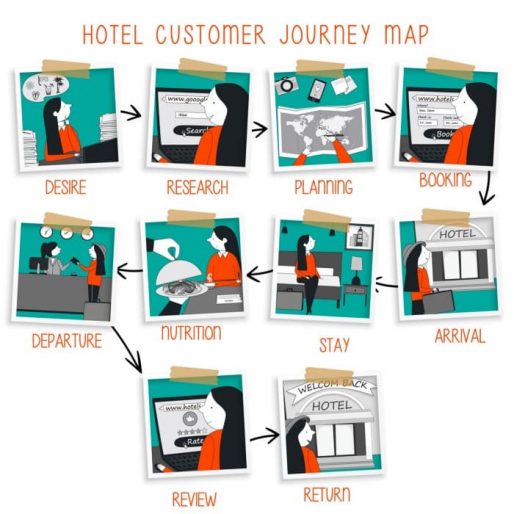
Understanding the customer journey map (CJM) of the target client persona is critical before beginning any marketing effort. Marketing actions are aimed at customers based on where they are on the journey map; otherwise, what you’re trying to say loses its context and relevance. CJM looks somewhat like this for a leisure traveler.
The above CJM is of a leisure traveler, it could be different for each segment or customer persona. In most industries, customer segmentation is done on the basis of either geographic, demographic or need and benefit. In hospitality, generally, customer segmentation is done on the basis of purchase occasion or reasons behind the travel, like — Transient, Leisure, Corporate and so on.
Charting out CJM for each customer persona and designing a hotel marketing plan around each persona will give a tremendous boost to your topline. The primary reason of planning campaigns using CJM is to plan marketing campaigns and activities at each stage so that it encourages a potential customer to take action and move on to the next stage in the journey map, ultimately resulting in a purchase.
Let us discuss the different stages of the CJM before we dive into the channels.
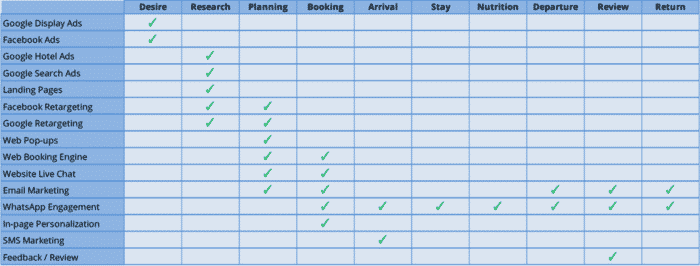
Desire Stage
This is the stage where the potential customer either has a desire to go on a vacation or that desire has not even started in his mind. This is where the targeting journey starts.
But how do you target a potential customer, who has never stayed at your hotel, has had no interaction with your hotel, does not even know your hotel exists, all he has is just a thought to go on a holiday or sometimes not even that. How to do it is explained in Google Display Ads and Facebook Ads section under Marketing Channels.
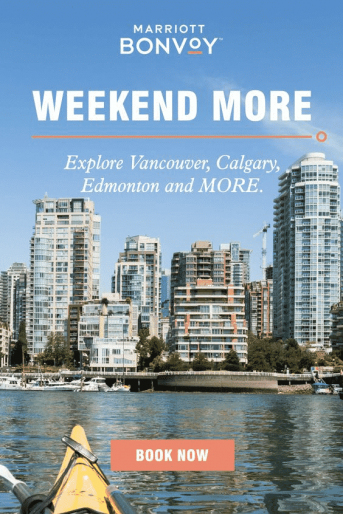
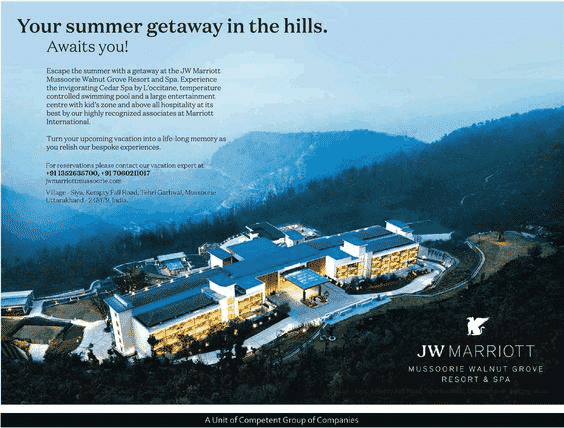
The hotel’s marketing campaigns at this stage should be focused on igniting that vacation desire and push the customer to further research about a vacation. Here are some examples of content ideas.
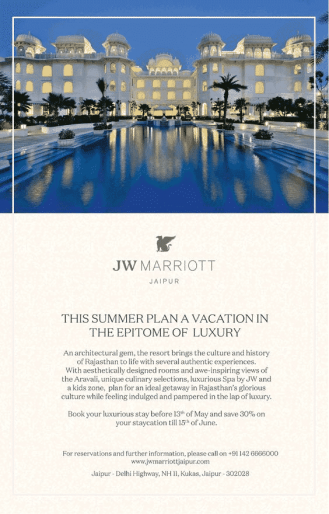
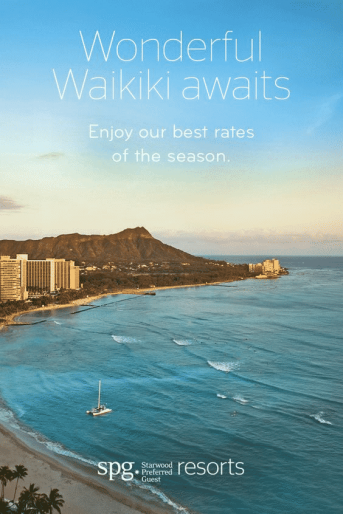
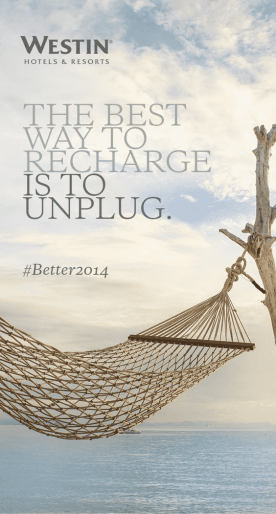
Content Ideas for Igniting Vacation Ideas
If you observe the content on these ads, you’ll notice that very little about the hotel is mentioned. Rather focus is on the “taking a vacation” and “destination”. You can also notice the emphasis is on keywords like “weekend”, “summer”, “unplug”, “vacation”, “getaway” and so on.
Imagine if you have a resort in Goa and a potential customer from Bengaluru has seen your ad multiple times over the week with the title “Unwind in Goa this Weekend”. Back in his mind, his desire to be in Goa this weekend is being built. Now what you need to do is to cement that desire and give the customer inspiration in your brand.
Google Display Ads and Facebook Ads are the two main channels you can leverage at this stage.
Research Stage
Every brand, every website out there is trying to capture customers’ attention at this stage and hence this is the most difficult stage for execution. This is the stage where the potential guest starts their research on destinations, flight fares, hotels, and everything else. At this stage, customers start doing google searches like these.
“hotels in goa”
“bangalore to goa flights”
“sightseeing in goa”
“best places in goa”
“best restaurants in goa”
“things to see in goa”
“budget hotels in goa”
“best outdoor activities in goa”
Now is the time when search engine marketing (SEM) and search engine optimization (SEO) strategies should kick in. A common SEO/SEM approach will not work here and hence this is where you need to be really creative. The first results page for the above search is a real battle place for those big brands. Even the major hospitality chains like Marriott, IHG, and Accor find it difficult to find a position on the first page. The first page is mostly taken over by OTAs — Booking.com, MakeMyTrip, Expedia, Trivago, and other players. Being a battleground doesn’t mean that you have to back out, rather be creative.
A mix of organic and paid marketing is your chance to a higher visibility and customer attention at this stage. Here are some hotel marketing tips to get you noticed in the research stage:
Regularly sponsor a popular vlogger in your destination.
Apart from your regular youtube content, try to post at least 1 video related to your destination, every month.
Your goal at this stage should be to bring the customer to your website and capture their details and consent for further marketing:
Capture opt-in for web push notifications. Web Push Notifications are explained later down in this article.
Capture email ID using a Web Pop-up, Chat or even through your booking engine.
By end of the research stage, the customer would have made up his mind on things like where to stay, which time of the year, with who he is traveling, and so on.
Planning Stage
The planning stage is the stage where the customer is deciding on things like which hotel, how to go, how much to spend, exact travel dates, which room, how to commute, etc.. This is the stage the customer will have tons of questions and doubts.
The two objectives you need to focus at this stage are:
Helping the customers with information and clarifying doubts. This will create a bond between your brand and the customer.
Communicate the benefits of booking directly with the hotel.
This is the stage where your blog articles, your website chat, email, and telephone support should help the customer and build his confidence. The highest level of engagement that can be expected is chat, call or email. If you have received either a chat, call or email, you stand a higher chance of the customer booking your hotel. You can call these customers as high-intent customers.
At this stage, all your focus should be on building enough confidence and convincing the customer to book directly.
Booking Stage
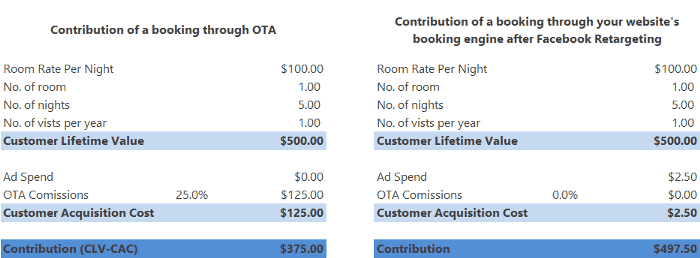
The customer is all set to make a booking. Now the most pressing question is, which channel will the customer use to make the booking — OTA, Offline Agent, or Direct? This is a very crucial stage because if your customer goes ahead with an OTA booking, it could easily shave 25% off your nightly rate as commissions, and the offline agent route could even be more expensive.
This is not new information for hoteliers, I am just overemphasizing it — Have a compelling offer for customers to book directly rather than on OTA or agent route. Without this, all your hotel’s marketing efforts could run into the drain. Every hotel these days have a direct booking offer, and chains will have a loyalty program as well. So make your offer more compelling than what competitors are offering.
A few key things for this stage are:
You need to have a web booking engine on your website. Choose a web booking engine that can manage the offers and freebies you are offering your customer.
Have an offers page on your website which is updated with latest book direct offers. This page URL can be used by your agents to send to your customers during a chat or email conversation.
Establish automations for timely transactional emails and notifications. Don’t make your guests call up the hotel repeatedly for booking confirmations.
Arrival Stage
Soon after the guest books your hotel, there is a small window between the booking and the actual arrival, it could be a day, a week, a month, or even months. Based on the booking window there are numerous creative things you can do to increase the excitement level of the customer, as well as upsell and cross-sell your services. Following are some ideas you can consider.
Send them links to your most popular blog articles about the destination.
Send them a list of activities they could do in your hotel.
If you have a web-check-in facility, send them a link to it, few days before arrival.
Ask them for WhatsApp messaging opt-in.
Ask them to pre book their meals or spa services.
Offer them a discounted upgrade.
Stay and Nutrition Stage
Stay Stage and Nutrition Stage are the two stages where your guests are actually utilizing your services and are continuously evaluating how good or bad your services are.
Three things to focus on at this stage:
Handling service requests.
Seek continuous feedback from the guest.
Cross sell your restaurant, spa and other services.
Some hotels have their own white-labeled apps, I really doubt how much guests value these apps or take the effort to download them. To me, WhatsApp is the best medium to leverage during this stage.
Departure Stage
The guest is preparing to return home and is in the process of check-in out from your hotel. Relevant things to engage customers at this stage are:
Stay details and invoice in email for future reference.
A thank you email from the General Manager.
Your hotel marketing should not end here. This is where the marketing funnel starts again! From this point, your guest should be put into a “Past Guests” bucket where they should be triggered for a longer marketing journey to return to your hotel for another stay.
Review Stage
Once the guest has reached back home is the time for you to ask for a review. You may ask the guest to post a review on Social Media, Google, or TripAdvisor; whatever channel you believe your future guests are seeking reviews about your hotel. You can offer your guests a special discount or package for their next trip if they complete the review.
Return Stage
Because the probability of a guest returning is much lower when compared to other industries, hotels tend to completely abandon their past guests. This is very wrong decision hoteliers take. Most hotels literally have no strategy to engage with past guests. This is because they do not fully understand the benefit of repeat customers. Here are reasons why you should start focusing your past guests:
You can service them better — you already know their likes and dislikes, you have a chance of servicing them better, resulting in a better guest satisfaction. The guests also feel more comfortable during their repeat stays because they get familiar with your employees and the hotel itself. The guests starts to develop an emotional bonding with the hotel.
Word of mouth (WOM) — the most powerful forms of marketing. It is very difficult to activate WOM otherwise, but when the guest is emotionally attached to your hotel, they spread the word to their friends, family and even social media. Researches say 92% of consumers trust their friends over traditional media.
No to worry about OTAs hijacking your guests — when you start to have more of repeat guests, you bottom line improves, because repeat guests always book with you directly. It takes time to even have 1% of your occupancy filled with repeat guests. If you have a proper past guest engagement strategy in place, you can have even 10% or more of repeat guests or at least referrer guests who come direct through WOM.
Repeat guests spend more — Customers who are repeat customers are more inclined to upgrade and purchase more expensive products or services. It all comes down to building trust. Eating at the hotel restaurant, feeling confident about the standard of food offered via room service, and using any other hotel facilities will build trust, which will lead to a higher level of revenue.
New customers are expensive — Imagine the money tap you have kept open to attract new customers and the strategies you build to divert OTA booking to direct. These expenses are not incurred on past guests. Attracting new customers costs five times more than keeping an existing customer. This is largely due to advances in technology and the associated costs and the increasing cost of marketing, including cuts given to online booking sites.
Upselling is easier with repeat customers — Loyal guests spend more money, usually because they are more familiar with what is on offer at a hotel they have visited before. In addition, loyal guests often stay longer. Even tips to hotel staff by repeat guests tend to increase. The trust repeat customers have in a particular hotel makes it easier to persuade them to buy into upsells than customers who are completely new.
Hotel Marketing Channels
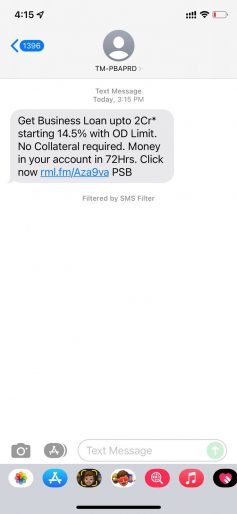
There are numerous channels you can use to communicate with your customers. I have explained a few popular ones which are widely used and are essential in your marketing automation. Whatever channels you use, consider if the channel is preferred by your customer to receive marketing communications. For example, someone who checked your website does not expect to receive an automated call with a pre-recorded message with offers. Insurance companies and financial institutions do that, Not Hospitality! The moment you do this, consider you’ve lost that customer. Please do not bombard messages on your customers.
Google Display Ads and Facebook Ads
Google Display Ads and Facebook Ads can be used to generate desire and can be continued through Research and Planning stages. However, the ads that are displayed at each stage should focus on what the user needs during the customer journey. A standard ad throughout these stages will be a waste of money.
Desire Stage — Ads that inspire the customer to take a vacation.
Research Stage — Promote peculiar feature or a package your hotel offers.
Planning Stage — Promote direct booking benefits and offers.
How to plan your display ad campaigns for the desire stage?
Rember, the potential customer either have no intention of taking a vacation or only have thought of it. How can we target these customers?
Leverage historical data from PMS
The PMS stores all guest data including, age, city, country, booking date, check-in, and check-out dates, and so on. Export these data and arrive at weekly aggregate data of the following:
City & country wise contribution
Average Booking Window
Age groups of your guests
Optionally, to make your data more reliable, compare this data with dates of historical events to see if the demand was generated by a one-off events in the past. For example, if there had been a doctor’s conference happening in the city, there would have been a surge in your bookings. But this doctor’s conference is not expected to take place in the same city every year, and hence this one-off event. The forecasts during this period should be normalized.
You could also compare the trends with school holidays and seasons in respective countries, you’ll definitely find correlations.
Now Google Display Ads and Facebook ads should be configured to target geographies and age groups for a period around the booking window. For example, if your top country for the last week of December is Australia and the average booking window is 8 weeks, the ad configuration should be as follows:
Target Geography: Australia
Age Group: 35–45 years
Start Date: October 25th
End Date: November 30th
Additionally, you can specify the interests and specific demographics of the target customer.
Facebook allows advertisers to hone in on users based on a variety of other demographic parameters, including education, financial, life events, parents, politics, relationships, work, and more.
Several of these demographic categories can be beneficial for hotels. For example, the “parents” category can be great for properties that are family-friendly and can allow you to promote specific amenities that are attractive to certain age groups; babies might love the splash pool while teens will love your waterslides. The “financial” category can help hotels reach personas based on income or net worth. Are you a budget-friendly property? Hone in on users with a lower income (ex: $25,000 — $50,000). Are you a high-end property? Target users with a larger income (ex: $100,000+). Are you a romantic property? Target users by their anniversary or who are “recently engaged”. The options are only limited by your creativity!
Interest-based targeting allows advertisers to hone in on platform users with specific interests. Selecting Travel, of course, can help hotels better define the traveler profile. Options here include important location-based travel elements, like “beaches” or “mountains”, and generic categories, like “vacations” or “adventure travel”. Does your hotel offer a unique emphasis on health and wellness? If so, interest categories like “yoga”, “running” and “meditation” might be highly relevant. Do your property offer eclectic or exciting on-site dining or beverage options? If so, specific food and beverage targeting can help you reach hip, happening foodies. Just like demographic targeting, interest targeting is only limited by your imagination.
You might need to create as many ad campaigns or ad groups based on the Weekly-Geography mix, because travel patterns change region to region and you have 52 weeks to manage, hence always better to automate and schedule it.
Google Hotel Ads
You are already aware of the Google Hotel Ads or your hotel is already listed here through one of the OTA feeds. Google Hotel Ads is a meta-search service offered by Google that displays hotels in a locality. It also offers direct booking features and many advanced display ad options.
Attract travelers who are actively looking for a hotel in a particular area. Hotel ads contain your company’s name, hotel name, price, and text callouts to highlight the unique benefits of booking through your site.
Tailor a hotel’s prices by a hotel’s availability and traveler itineraries.
Send customers to a website to book, or allow them to book on Google.
Pay for an ad only when someone books a hotel. Or fine-tune your bidding by factors such as device type, the traveler’s country, or length of stay
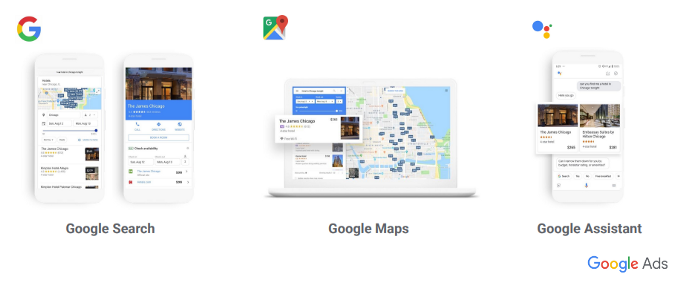
Hotel ads are displayed in the following formats.
If only the OTA feed is connected to Google Hotel Ads, then there are high chances that your bookings are converted by OTAs. You need to connect Google Hotel Ads to your web booking engine from where daily rates are fetched by Google. This will enable direct bookings to your website.
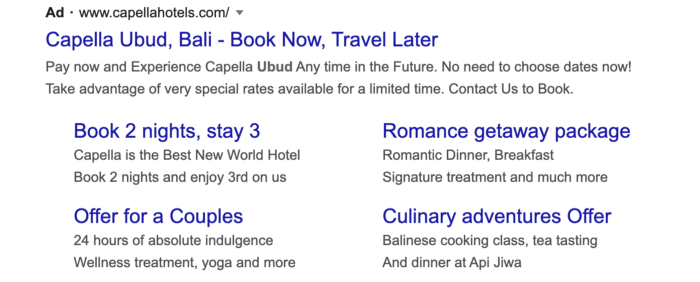
Search ads are those text ads that get listed on top of the Google search results pages.
It is difficult to get to this position because OTAs and chains would be bidding extremely high for these positions, which might turn out to be really expensive for your brand. These are some safe spots where you should run your Google Search Ads.
Target your brand keywords and hotel name, so that OTAs do not brandjack your name.
Target hyperlocal, instead of targeting “hotels in goa”, try to target “hotels in margoa” or for long tail keywords try things like — “hotels in goa with private pool”.
Web Push Notifications
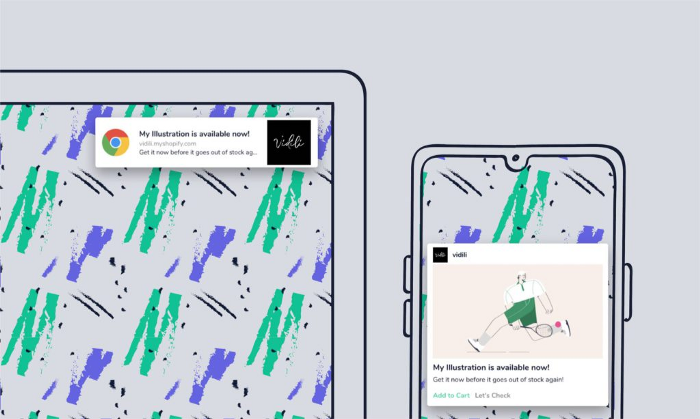
Nothing new here, we all have come across Web Push Notifications on our browsers and mobiles.
Honestly, these push notifications have become really annoying for some users, who ignorantly accept notifications when they visit a site. It then becomes a real mess. The above article explains some interesting gimmicks brands do to deceive the user and accept push notifications. I’d suggest staying away from those gimmicks and being true to your customers.
So, in this world of spammy marketing campaigns, the only way to succeed is to not become so PUSHY and stay relevant to your user. If you can’t find any relevance, DON’T SPAM the people who love your brand. Secondly, just because you have an additional channel at your disposal, don’t send out the same content to all the channels. Here are some ideas to utilize push notifications in your marketing and yet stay relevant.
Upsell and Cross Sell — once a user completes a booking, you can utilize push notifications to nudge users to take action on booking upgrades or booking additional services like Spa.
Content marketing — if your hotel has a content marketing strategy that promotes local sightseeing and activities, you could push these content to the guest to visit your hotel’s blog.
Re-engagement — you can considering re-engagement messages to guests after a period of 6 months or 1 year to take action to visit you again, add a discount to motivate them.
Web Pop-ups
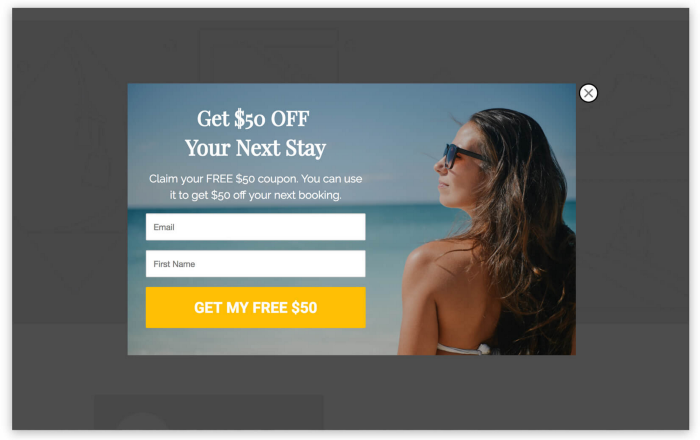
Web pop-ups are small window that appears within your website. Just like this one.
Use these to capture customers’ email ID in exchange for a discount code, an offer, or even for destination-related articles. This can be used in the Desire, Research, or Planning stages. The email IDs captured can be used for further email campaigns.
Website Live Chat
The Most Powerful Lead Generation Tool
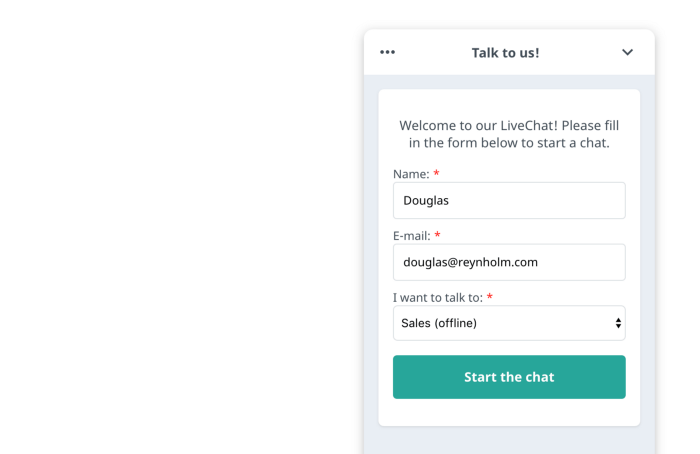
When a customer visits your site and wants to clarify something — maybe your check-in and check-out time or what types of cards are accepted, they often look for a phone number or a chat option to talk to live agents. If you have a live chat installed on your website, it can capture the name and email ID of the visitor using a pre-chat form.
Website live chat is the most powerful lead generation tool. Because — visitors who enter your chat are people in need of the service and are in the consideration stage of the marketing funnel, ie. they are considering booking a room or an event. This is no random lead, they are on your chat seeking more information, you should never let go of them.
Booking Engine
Like the website live chat, Web Booking Engine (WBE) is also a source of capturing high intent leads. But for some reason, most booking engine providers do offer to capture these leads.
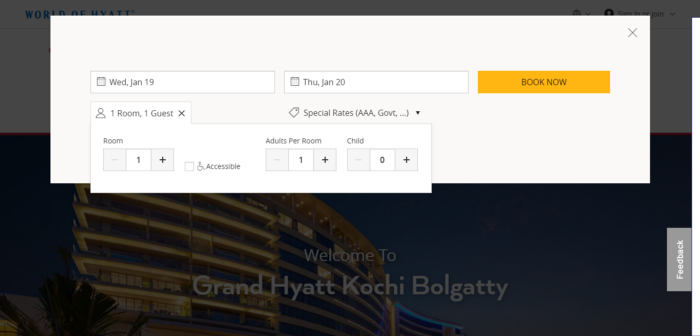
Here is a screenshot of Grand Hyatt’s WBE.
The bookings engine only captures Check-in Date, Check-out Date, No. of guests, and no. of rooms. Why on earth are the booking engines not capturing the name and email address of the visitor? Are they trying to reduce the user interactions? The name and email ID need not be captured at every search, it only needs to be done once. Are they afraid, that the user will not check prices if they ask for a name and email ID? Am I missing something here?
What I think is that someone with high intent does not matter sharing their name and email ID. It is a really good way to filter out spammers and rate shoppers. Also, it could help you get creative with In-page Personalizations which your customers would feel more connected to.
However, if your booking engine supports capturing user email IDs and also gives you access to the specific user’s search dates and other interactions, you can get really creative with in-page personalizations and abandoned booking emails (Google for abandoned cart reminders to learn how it is used by e-commerce companies).
Google and Facebook Remarketing
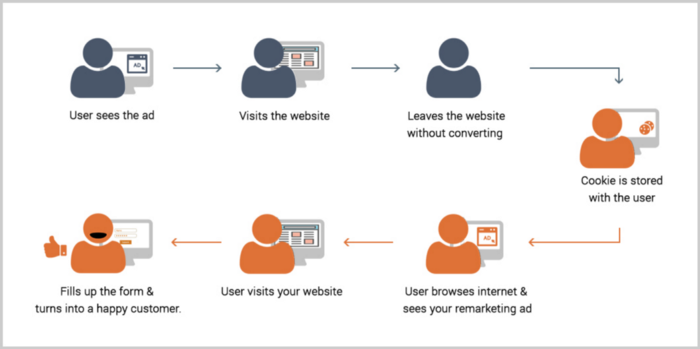
Retargeting or remarketing is the process of finding people who’ve visited your website and then using this data to serve them ads on Facebook and Google Display Ads. You can then run advertising campaigns to target those people and convince them to come back to your website and make a reservation.
Now retargeting all visitors who come on your website could be a huge waste of money. You can configure on Facebook Ads Manager to who to serve your ads to — known as Custom Audience. My recommendations for retargeting are:
Rooms
Top 25% of visitors who have spent the most time on your website in the past 14 days.
Visitors who have visited your web booking page in the past 14 days.
Configure ads manager to exclude visitors who have completed the booking. Your booking confirmation page URL can be used to exclude these visitors.
Events & Conferences
Top 25% of visitors in the past 60 days who have visited your Events or Meetings page.
Do not exclude visitors, because once they have contacted the hotel it may take weeks for a client to finalise the venue. So in the meantime, repeated ads will help to keep your brand or venue in the forefront of customer’s mind.
A marketing automation platform is not really necessary to use basic Facebook Retargeting, you can simply install the Facebook Pixel on your website and start managing the ads yourself. Installing the Facebook Pixel will need some technical knowledge, but everything else is fairly simple.
Email Marketing
I hate marketing emails. It floods the inbox and makes you miss more important emails. I am guessing everyone feels the same about email marketing campaigns. This is why you need to keep your email marketing campaigns more relevant to the user than any other channel. You need to have proper control over the frequency and content, otherwise, your users will start hating your brand. So here is a list of emails that I think hotels could use for engagement.
Booking confirmation — an email containing the booking details like reservation number, room details, total amount paid and so on. Most hotels use this. Even if they do not have an automated or fully integrated system, a reservation agent sends this confirmation email to guests.
Pre-arrival — an email a few days before the guest is expected to arrive. The email could contain a small welcome note from the general manager, places to visit around the hotel, few details about what the guests can do within the hotel — spa, swimming pool or restaurants. If you have a web check-in system, you can also ask the guest to do a web checkin for smooth check-in at the time of arrival.
Departure — as soon as the guests checks-out, an email consisting of all the charges and a copy of the invoice could be sent to the guest so that the guest have it safely stored in their inbox and can retrieve it whenever they want.
Thank you and feedback email — as soon or within 3 days of departure, a thank you note from the general manager. you could also ask your guests to review your hotel on tripadvisor or google. Or you can have an NPS form link attached within the email. You could also offer a 10% discount on their next stay if they complete your feedback form or post a review on tripadvisor.
Feedback reminder email — if you did not receive a feedback or response on your NPS form, you could send one more email to your guest reminding him for the feedback and the discount awaiting them.
Advanced birthday and anniversary wishes — 45 or 60 days prior to anniversary or birthday of guests who have stayed with you, you could send them a deep discount or freebies which they could utilise on any day of their birthday/anniversary month. 15 days prior to the birthday/anniversary date, you could send out another email to remind them to utilise their offer.
PS: Keep in mind that there is a risky element while wishing anniversary — it is not necessary that the couple is together when they receive your email :D.
Birthday and anniversary wishes — you could automate birthday wishes to your guests.
New property openings — keep your customers updated about new property openings under your brand, so that they can consider it for their next holiday. Offer them a special discount for at this new location.
Additionally, these are the emails, I’d recommend being sent to your corporate and agent bookers.
Birthday and anniversary wishes — follow the same strategy you follow for your guests. If you want, you could pump up the discount or offer a free room to your bookers on their special day or a spa treatment. Because, not all bookers can afford your hotel even after a deep discount, same time bookers are critical for your business. This a way you can pamper them.
Restaurant & Spa Promotions — hotels frequently host food festivals, it is more relevant to send these promotions to your bookers rather than sending it to your entire guest list. Your guests are most probably not from your same city and hence makes no relevance to them.
SMS Marketing
Just like emails, people get bombarded with an overwhelming amount of text messages. It’s important that your business doesn’t add to that stress by sending too many texts. If you don’t have anything important to say or offer, it’s best not to send a text at all. By sending out only your most exciting texts, you’ll avoid annoying customers. Plus, when they do see that they’ve gotten a text from you, they’ll know it’s something good.
Before you plan on starting SMS campaigns, please make a note of this. India, In an effort to control promotional spam, SMS fraud, and unsolicited messaging, the TRAI has enforced new guidelines for SMS marketing. It mandates the whitelisting of all SMS templates and registration of your company’s entities, Sender IDs (Headers), and user consent in a centralized DLT portal provided by Indian mobile operators.
Use SMS for Hyperlocal Marketing
For hotels, SMS is not a channel that works well with your guest’s list, however, it is quite effective for hyperlocal marketing to promote your staycation offers, food festivals, spa or gym packages. But refrain from overdoing it.
Building your hyperlocal list
Employees — Who else can better promote your business than your employees? When you’re running a hotel with 100 or 200 employees, it is possible that all the employees aren’t aware of your promotions. Secondly, employees mostly live close to your hotel and hence their network is also local, it is more easier to spread word of mouth hyperlocal through employees.
Feedback Forms — You must be already having manual or digital ways of capturing feedbacks from your walk-in restaurant guests and spa customers. Look for people who are local in those feedback forms and build a list.
Public Relations — Every hotel have someone taking care of public relations and statutory liasoning with tax offices, police station, municipality, health department, press and so on. Get a list of all the people they work with. The list might not be more than 20 or 30, but these people are well networked and they already know your brand. They wouldn’t mind knowing more about your business.
Corporate Bookers — Ask the sales department for their database of corporate bookers and agents. This list can be anywhere between 1000 to 5000.
Do’s and Don’ts
Don’t buy or subscribe to databases of people who have never interacted with your brand. This is third-class marketing. People will start hating your brand.
Always have a provision for recipients to opt out from your text message campaigns. Reminding users that they can opt-out at any time will help you avoid annoying them and it will also ensure that your SMS marketing list is filled with people that are actually interested in getting your messages.
Do not forget to mention your brand! Even if your brand is small or big, people trust brands, because when a company is trying to build a brand, it is trying to build a personality of the brand and hence people are more inclined to trust brands.
Here are two screenshots from text message marketing I recently received.
The first one is a random promo message. I do not know from which company it is, there is no option to unsubscribe it and lastly, I am definitely not their customer.
The second one is obviously from Etisalat, I am definitely their customer, they have properly detailed on how to unsubscribe from it.
Which do you think has a higher probability of conversion?
WhatsApp Engagement
As of March 2020, WhatsApp had two billion monthly active users, up from over 1 billion MAU in February 2016. The service is one of the most popular mobile messaging apps worldwide. Every day, at least 60 billion messages are sent via this messaging app.
So will WhatsApp soon replace SMS marketing? Not exactly! You may have observed, even after so much user adoption of WhatsApp, you receive so few marketing messages through WhatsApp than through SMS. Even if you receive marketing messages, it is highly unlikely that you received it from a reputed brand or company. This is because Meta does not want WhatsApp to be another broadcasting channel, rather it wants brands to use WhatsApp as a customer engagement tool or a customer service channel, and hence they have built restrictions on what can be sent to customers. This is controlled through the following policies:
User Opt-ins — brands are not allowed to send messages to WhatsApp user without their consent. You can get this consent through various other channels — SMS, Email, QR Codes, Push notifications and so on.
Whitelisting Message Templates — Now if you have the consent of the user, you can initiate a conversation with the user using a pre-defined message template. But this is limited to the first message only, and to continue conversation, the user has the initiate by responding to the message. The template could contain variables such as — name, reservation number, amount etc.. But the format/template of your messages should be submitted to and approved by Meta through a WhatsApp Service Provider (WSP).
A WhatsApp message template could look like this:
“Hi, name. “Thank you for choosing us. We would like to confirm your reservation at hotel name between arrival date and departure date. For more details on your booking and hotel, please visit the URL. We hope you will enjoy your stay and we look forward to welcoming you !”
24 Hour Window — Once the user responds to your above message, then you are open to chat freely, but only for providing support or assistance to the customer. Again, this is restricted to 24 hours. To continue the conversation, either the user has to initiate the conversation again.
Yes, it is a little complicated and is not easy as opening your WhatsApp and texting your user.
How can your hotel utilize WhatsApp for a better guest experience?
Sending out notifications and standard messages — Here are a list of message templates you could use to engage with your guests at different stages of their stay:
Pre-stay — “Hi, Jennifer. “Thank you for choosing us. We would like to confirm your reservation at hotel name between arrival date and departure date. For more details on your booking and hotel, please visit the URL. We hope you will enjoy your stay and we look forward to welcoming you !”
Check-in — “Hi, Jennifer. Welcome to hotel name. Your WiFi is HappyGuest. Here is a personalized welcome page that has all the relevant details about your stay, right from the shuttle to nearby recommendations Please visit the URL Breakfast is served from 6:30 to 9:30 AM. We also have Happy Hours for our guests every day from 5pm-10pm. Feel free to text us here if you have any questions. Enjoy your stay”
During the stay — “Hi, Jennifer. We hope that you are doing well. How is your stay so far? Please let us know if we can assist with anything during your stay. Take care”
Check-out — “Hi, Jennifer. Thank you for choosing to stay with us. We hope you had a wonderful stay. We’d really appreciate if you just take a moment to share your experience with us:* the link.* We look forward to the pleasure of hosting you again. Safe travels— {Name}, General Manager”
Opt-in links in your transactional emails — we earlier discussed a series of transactional email from pre-stay to post-stay feedback. Try to include the open-in link in every email. Tell your customers that they could conveniently WhatsApp them for anything and everything even for room service during their stay.
SMS Opt-in link at the time of check-in — As soon as the customer is checked-in, let the system send your guest a welcome with an opt-in link. Also, ask your front desk to intimate your guests upon check-in that your hotel has a WhatsApp customer service, where all the services are available over WhatsApp.
QR Codes everywhere — put up QR codes that leads to opt-in URL everywhere — in the rooms, inside the elevator, on your keycard pouches, at your reception and everywhere you can think of. Here are some great examples of how hotels implement the QR opt-in system.
Examples of how hotels implement WhatsApp QR
Execute the Strategy in Reverse Chronology of CJM
When you are in a senior role, you have too many things to take care of and it becomes difficult to find time to strategize, execute and analyze a hotel marketing automation strategy. The easiest approach is to open one box at a time, ie., take one stage of the journey at a time and implement it. Also, my suggestion would be to implement it in the reverse order of the journey. If you are considering implementation in a forward direction, it does not always make sense to implement a stage without the next stage. For example, If you are done implementing automation for Research and Planning stage, these implementations do not make sense if you have no proper systems to capture direct booking. For this reason, reverse implementation is the best approach.
Here are the steps you need to take next to implement your hotel marketing automation.
Step 1: Identify a partner to help you execute marketing automation. If you’re tech savvy, you can rely on out-of-the-box platforms.
Step 2: Chart out your customer journey map.
Step 3: Plan what to communicate and which channel to use at each stages.
Step 4: Identify what KPI you will use at each stage to measure success of your strategy.
Step 5: Start implementation from the bottom of the customer journey map.
Step 6: Analyse the results of your strategy.
Step 7: Optimise your strategy to yield better results.
Here is how you can plan what channel to use at what stage. Not necessary to follow the same, you can create your own strategy. You can also use a detailed customer journey map template to plan your marketing.
Understanding Profitability
To analyse the profitability of acquiring customers through any paid channel, you need to understand the concepts of Customer Lifetime Value and Customer Acquisition Cost.
Customer Lifetime Value (CLV) — is a measure of the total income a business can expect to bring in from a typical customer for as long as that customer remains your customer.
For example, A couple in the US decides to travel to India for holidays this year. They book a room at your hotel for 5 nights and your room costs them $100 per night. So the total revenue you earn on this booking is 1 Room x 5 Nights x $100 which is equal to $500. Now, since this couple is from USA, and is travelling for holidays, then it is very unlikely that they are going to return to your hotel this year or even next year or ever. So here you CLV is $500.
In case if you are promoting a staycation or workation, then there are high chances that your customer would return the same year or next. In that case your CLV is higher than a foreign customer. If the customer returns another time, then your CLV is 1 Room x 5 Nights x $100 x 2 Visits, which is equal to $1000.
Let us also take an example of meetings and events. Let us consider that your tariff for hosting a wedding reception is $30 per guest. A couple hosts their wedding reception at your hotel with 100 guests. In this case your CLV is $3000.
I have taken the above examples for better understanding. Generally CLV is not calculated customer to customer, rather it is calculated as an aggregate, or you can even rough estimations for each of your customer segments.
CLV is not a standard metric in the hospitality industry and hence it is not necessary that you establish a system to calculate your CLVs, the above explanation is for you to have a calculation at the back of your head while deciding on where to spend your ad budgets.
Customer Acquisition Costs (CAC) — CAC is the cost of convincing a potential customer to buy a brand’s product or service, in the case of hotels — booking a hotel room or confirming an event at the hotel.
To calculate CAC, the marketer will need to divide all the costs spent acquiring customers against the number of new customers picked up. For example, if a hotel spends $500 on Facebook Ads yearly and receives 200 new customers, the CAC is $2.5.
Here is a working of how to calculate your contribution for booking received through OTA and through your website.
Measure the Results
Here are my suggestions on what KPIs to use to measure the success of your marketing efforts.
Desire — Click Through Rate (CTR)
Research — New Visitors to your website
Planning — Returning Visitors to your website
Booking — Revenue from Direct Bookings
Arrival — Revenue from Upsells & Cross Sells Prior to Arrival
Stay & Nutrition — No. of Service Requests Received
Departure — Additional Revenue Generated During the Stay
Review — CSAT/NPS or Review Ratings
Return — New vs. Return Guests
KPIs mentioned for Arrival and Departure might not be easily available through most PMS, you will have to do some workaround or find a relevant KPI for the same.
Additionally, the following KPIs should also be tracked regularly.
Online Marketing ROI
Customer Lifetime Value
Customer Acquisition Cost
Conclusion
There are hundreds of channels out there that can be used to engage customers at different stages of their customer journey, like — Apple Business Chat, Instagram, LinkedIn, Youtube, TikTok, Automated Calling Systems and even IoT can be utilized in marketing automation.
As a brand, your goal should never be to bombard messages on your customers to capture their attention but to improve conversions while staying relevant. Marketing automation is the right approach to deliver the most relevant messages to your guests with high levels of personalization. After all, hospitality is all about personalized service and utmost attention at all times.
I was doing some research on companies that offered all-in-one marketing automation systems when it occurred to me that the hotel sector continues to underestimate the power of marketing automation. Certainly, the chains make extensive use of it, but what about medium-sized hotels and independent chains? Because the hospitality sector is so operationally intense, General Managers and owners rarely have time to worry about anything else.
Marketing automation is a method of automating repetitive marketing tasks using technology. Marketing teams may automate time-consuming processes like email marketing, social media posting, and even ad campaigns, not just to save time but also to deliver a more personalized experience for clients.
Executing marketing automation requires some degree of technical expertise. So if you are in one of those senior roles, I advise that you get creative and develop strategies, additionally hire someone or an agency to execute it for you. This article will give you an overview of what tools and some ideas around these tools, to help you strategize a better marketing plan. However, marketing automation has a learning curve that you have to commit to and also involves rigorous trial and error before it actually starts generating positive ROI. So give it some time.
Hotel Customer Journey Map
Understanding the customer journey map (CJM) of the target client persona is critical before beginning any marketing effort. Marketing actions are aimed at customers based on where they are on the journey map; otherwise, what you’re trying to say loses its context and relevance. CJM looks somewhat like this for a leisure traveler.
The above CJM is of a leisure traveler, it could be different for each segment or customer persona. In most industries, customer segmentation is done on the basis of either geographic, demographic or need and benefit. In hospitality, generally, customer segmentation is done on the basis of purchase occasion or reasons behind the travel, like — Transient, Leisure, Corporate and so on.
Charting out CJM for each customer persona and designing a hotel marketing plan around each persona will give a tremendous boost to your topline. The primary reason of planning campaigns using CJM is to plan marketing campaigns and activities at each stage so that it encourages a potential customer to take action and move on to the next stage in the journey map, ultimately resulting in a purchase.
Let us discuss the different stages of the CJM before we dive into the channels.
Desire Stage
This is the stage where the potential customer either has a desire to go on a vacation or that desire has not even started in his mind. This is where the targeting journey starts.
But how do you target a potential customer, who has never stayed at your hotel, has had no interaction with your hotel, does not even know your hotel exists, all he has is just a thought to go on a holiday or sometimes not even that. How to do it is explained in Google Display Ads and Facebook Ads section under Marketing Channels.
The hotel’s marketing campaigns at this stage should be focused on igniting that vacation desire and push the customer to further research about a vacation. Here are some examples of content ideas.
Content Ideas for Igniting Vacation Ideas
If you observe the content on these ads, you’ll notice that very little about the hotel is mentioned. Rather focus is on the “taking a vacation” and “destination”. You can also notice the emphasis is on keywords like “weekend”, “summer”, “unplug”, “vacation”, “getaway” and so on.
Imagine if you have a resort in Goa and a potential customer from Bengaluru has seen your ad multiple times over the week with the title “Unwind in Goa this Weekend”. Back in his mind, his desire to be in Goa this weekend is being built. Now what you need to do is to cement that desire and give the customer inspiration in your brand.
Google Display Ads and Facebook Ads are the two main channels you can leverage at this stage.
Research Stage
Every brand, every website out there is trying to capture customers’ attention at this stage and hence this is the most difficult stage for execution. This is the stage where the potential guest starts their research on destinations, flight fares, hotels, and everything else. At this stage, customers start doing google searches like these.
“hotels in goa”
“bangalore to goa flights”
“sightseeing in goa”
“best places in goa”
“best restaurants in goa”
“things to see in goa”
“budget hotels in goa”
“best outdoor activities in goa”
Now is the time when search engine marketing (SEM) and search engine optimization (SEO) strategies should kick in. A common SEO/SEM approach will not work here and hence this is where you need to be really creative. The first results page for the above search is a real battle place for those big brands. Even the major hospitality chains like Marriott, IHG, and Accor find it difficult to find a position on the first page. The first page is mostly taken over by OTAs — Booking.com, MakeMyTrip, Expedia, Trivago, and other players. Being a battleground doesn’t mean that you have to back out, rather be creative.
A mix of organic and paid marketing is your chance to a higher visibility and customer attention at this stage. Here are some hotel marketing tips to get you noticed in the research stage:
Regularly sponsor a popular vlogger in your destination.
Apart from your regular youtube content, try to post at least 1 video related to your destination, every month.
Your goal at this stage should be to bring the customer to your website and capture their details and consent for further marketing:
Capture opt-in for web push notifications. Web Push Notifications are explained later down in this article.
Capture email ID using a Web Pop-up, Chat or even through your booking engine.
By end of the research stage, the customer would have made up his mind on things like where to stay, which time of the year, with who he is traveling, and so on.
Planning Stage
The planning stage is the stage where the customer is deciding on things like which hotel, how to go, how much to spend, exact travel dates, which room, how to commute, etc.. This is the stage the customer will have tons of questions and doubts.
The two objectives you need to focus at this stage are:
Helping the customers with information and clarifying doubts. This will create a bond between your brand and the customer.
Communicate the benefits of booking directly with the hotel.
This is the stage where your blog articles, your website chat, email, and telephone support should help the customer and build his confidence. The highest level of engagement that can be expected is chat, call or email. If you have received either a chat, call or email, you stand a higher chance of the customer booking your hotel. You can call these customers as high-intent customers.
At this stage, all your focus should be on building enough confidence and convincing the customer to book directly.
Booking Stage
The customer is all set to make a booking. Now the most pressing question is, which channel will the customer use to make the booking — OTA, Offline Agent, or Direct? This is a very crucial stage because if your customer goes ahead with an OTA booking, it could easily shave 25% off your nightly rate as commissions, and the offline agent route could even be more expensive.
This is not new information for hoteliers, I am just overemphasizing it — Have a compelling offer for customers to book directly rather than on OTA or agent route. Without this, all your hotel’s marketing efforts could run into the drain. Every hotel these days have a direct booking offer, and chains will have a loyalty program as well. So make your offer more compelling than what competitors are offering.
A few key things for this stage are:
You need to have a web booking engine on your website. Choose a web booking engine that can manage the offers and freebies you are offering your customer.
Have an offers page on your website which is updated with latest book direct offers. This page URL can be used by your agents to send to your customers during a chat or email conversation.
Establish automations for timely transactional emails and notifications. Don’t make your guests call up the hotel repeatedly for booking confirmations.
Arrival Stage
Soon after the guest books your hotel, there is a small window between the booking and the actual arrival, it could be a day, a week, a month, or even months. Based on the booking window there are numerous creative things you can do to increase the excitement level of the customer, as well as upsell and cross-sell your services. Following are some ideas you can consider.
Send them links to your most popular blog articles about the destination.
Send them a list of activities they could do in your hotel.
If you have a web-check-in facility, send them a link to it, few days before arrival.
Ask them for WhatsApp messaging opt-in.
Ask them to pre book their meals or spa services.
Offer them a discounted upgrade.
Stay and Nutrition Stage
Stay Stage and Nutrition Stage are the two stages where your guests are actually utilizing your services and are continuously evaluating how good or bad your services are.
Three things to focus on at this stage:
Handling service requests.
Seek continuous feedback from the guest.
Cross sell your restaurant, spa and other services.
Some hotels have their own white-labeled apps, I really doubt how much guests value these apps or take the effort to download them. To me, WhatsApp is the best medium to leverage during this stage.
Departure Stage
The guest is preparing to return home and is in the process of check-in out from your hotel. Relevant things to engage customers at this stage are:
Stay details and invoice in email for future reference.
A thank you email from the General Manager.
Your hotel marketing should not end here. This is where the marketing funnel starts again! From this point, your guest should be put into a “Past Guests” bucket where they should be triggered for a longer marketing journey to return to your hotel for another stay.
Review Stage
Once the guest has reached back home is the time for you to ask for a review. You may ask the guest to post a review on Social Media, Google, or TripAdvisor; whatever channel you believe your future guests are seeking reviews about your hotel. You can offer your guests a special discount or package for their next trip if they complete the review.
Return Stage
Because the probability of a guest returning is much lower when compared to other industries, hotels tend to completely abandon their past guests. This is very wrong decision hoteliers take. Most hotels literally have no strategy to engage with past guests. This is because they do not fully understand the benefit of repeat customers. Here are reasons why you should start focusing your past guests:
You can service them better — you already know their likes and dislikes, you have a chance of servicing them better, resulting in a better guest satisfaction. The guests also feel more comfortable during their repeat stays because they get familiar with your employees and the hotel itself. The guests starts to develop an emotional bonding with the hotel.
Word of mouth (WOM) — the most powerful forms of marketing. It is very difficult to activate WOM otherwise, but when the guest is emotionally attached to your hotel, they spread the word to their friends, family and even social media. Researches say 92% of consumers trust their friends over traditional media.
No to worry about OTAs hijacking your guests — when you start to have more of repeat guests, you bottom line improves, because repeat guests always book with you directly. It takes time to even have 1% of your occupancy filled with repeat guests. If you have a proper past guest engagement strategy in place, you can have even 10% or more of repeat guests or at least referrer guests who come direct through WOM.
Repeat guests spend more — Customers who are repeat customers are more inclined to upgrade and purchase more expensive products or services. It all comes down to building trust. Eating at the hotel restaurant, feeling confident about the standard of food offered via room service, and using any other hotel facilities will build trust, which will lead to a higher level of revenue.
New customers are expensive — Imagine the money tap you have kept open to attract new customers and the strategies you build to divert OTA booking to direct. These expenses are not incurred on past guests. Attracting new customers costs five times more than keeping an existing customer. This is largely due to advances in technology and the associated costs and the increasing cost of marketing, including cuts given to online booking sites.
Upselling is easier with repeat customers — Loyal guests spend more money, usually because they are more familiar with what is on offer at a hotel they have visited before. In addition, loyal guests often stay longer. Even tips to hotel staff by repeat guests tend to increase. The trust repeat customers have in a particular hotel makes it easier to persuade them to buy into upsells than customers who are completely new.
Hotel Marketing Channels
There are numerous channels you can use to communicate with your customers. I have explained a few popular ones which are widely used and are essential in your marketing automation. Whatever channels you use, consider if the channel is preferred by your customer to receive marketing communications. For example, someone who checked your website does not expect to receive an automated call with a pre-recorded message with offers. Insurance companies and financial institutions do that, Not Hospitality! The moment you do this, consider you’ve lost that customer. Please do not bombard messages on your customers.
Google Display Ads and Facebook Ads
Google Display Ads and Facebook Ads can be used to generate desire and can be continued through Research and Planning stages. However, the ads that are displayed at each stage should focus on what the user needs during the customer journey. A standard ad throughout these stages will be a waste of money.
Desire Stage — Ads that inspire the customer to take a vacation.
Research Stage — Promote peculiar feature or a package your hotel offers.
Planning Stage — Promote direct booking benefits and offers.
How to plan your display ad campaigns for the desire stage?
Rember, the potential customer either have no intention of taking a vacation or only have thought of it. How can we target these customers?
Leverage historical data from PMS
The PMS stores all guest data including, age, city, country, booking date, check-in, and check-out dates, and so on. Export these data and arrive at weekly aggregate data of the following:
City & country wise contribution
Average Booking Window
Age groups of your guests
Optionally, to make your data more reliable, compare this data with dates of historical events to see if the demand was generated by a one-off events in the past. For example, if there had been a doctor’s conference happening in the city, there would have been a surge in your bookings. But this doctor’s conference is not expected to take place in the same city every year, and hence this one-off event. The forecasts during this period should be normalized.
You could also compare the trends with school holidays and seasons in respective countries, you’ll definitely find correlations.
Now Google Display Ads and Facebook ads should be configured to target geographies and age groups for a period around the booking window. For example, if your top country for the last week of December is Australia and the average booking window is 8 weeks, the ad configuration should be as follows:
Target Geography: Australia
Age Group: 35–45 years
Start Date: October 25th
End Date: November 30th
Additionally, you can specify the interests and specific demographics of the target customer.
Facebook allows advertisers to hone in on users based on a variety of other demographic parameters, including education, financial, life events, parents, politics, relationships, work, and more.
Several of these demographic categories can be beneficial for hotels. For example, the “parents” category can be great for properties that are family-friendly and can allow you to promote specific amenities that are attractive to certain age groups; babies might love the splash pool while teens will love your waterslides. The “financial” category can help hotels reach personas based on income or net worth. Are you a budget-friendly property? Hone in on users with a lower income (ex: $25,000 — $50,000). Are you a high-end property? Target users with a larger income (ex: $100,000+). Are you a romantic property? Target users by their anniversary or who are “recently engaged”. The options are only limited by your creativity!
Interest-based targeting allows advertisers to hone in on platform users with specific interests. Selecting Travel, of course, can help hotels better define the traveler profile. Options here include important location-based travel elements, like “beaches” or “mountains”, and generic categories, like “vacations” or “adventure travel”. Does your hotel offer a unique emphasis on health and wellness? If so, interest categories like “yoga”, “running” and “meditation” might be highly relevant. Do your property offer eclectic or exciting on-site dining or beverage options? If so, specific food and beverage targeting can help you reach hip, happening foodies. Just like demographic targeting, interest targeting is only limited by your imagination.
You might need to create as many ad campaigns or ad groups based on the Weekly-Geography mix, because travel patterns change region to region and you have 52 weeks to manage, hence always better to automate and schedule it.
Google Hotel Ads
You are already aware of the Google Hotel Ads or your hotel is already listed here through one of the OTA feeds. Google Hotel Ads is a meta-search service offered by Google that displays hotels in a locality. It also offers direct booking features and many advanced display ad options.
Attract travelers who are actively looking for a hotel in a particular area. Hotel ads contain your company’s name, hotel name, price, and text callouts to highlight the unique benefits of booking through your site.
Tailor a hotel’s prices by a hotel’s availability and traveler itineraries.
Send customers to a website to book, or allow them to book on Google.
Pay for an ad only when someone books a hotel. Or fine-tune your bidding by factors such as device type, the traveler’s country, or length of stay
Hotel ads are displayed in the following formats.
If only the OTA feed is connected to Google Hotel Ads, then there are high chances that your bookings are converted by OTAs. You need to connect Google Hotel Ads to your web booking engine from where daily rates are fetched by Google. This will enable direct bookings to your website.
Search ads are those text ads that get listed on top of the Google search results pages.
It is difficult to get to this position because OTAs and chains would be bidding extremely high for these positions, which might turn out to be really expensive for your brand. These are some safe spots where you should run your Google Search Ads.
Target your brand keywords and hotel name, so that OTAs do not brandjack your name.
Target hyperlocal, instead of targeting “hotels in goa”, try to target “hotels in margoa” or for long tail keywords try things like — “hotels in goa with private pool”.
Web Push Notifications
Nothing new here, we all have come across Web Push Notifications on our browsers and mobiles.
Honestly, these push notifications have become really annoying for some users, who ignorantly accept notifications when they visit a site. It then becomes a real mess. The above article explains some interesting gimmicks brands do to deceive the user and accept push notifications. I’d suggest staying away from those gimmicks and being true to your customers.
So, in this world of spammy marketing campaigns, the only way to succeed is to not become so PUSHY and stay relevant to your user. If you can’t find any relevance, DON’T SPAM the people who love your brand. Secondly, just because you have an additional channel at your disposal, don’t send out the same content to all the channels. Here are some ideas to utilize push notifications in your marketing and yet stay relevant.
Upsell and Cross Sell — once a user completes a booking, you can utilize push notifications to nudge users to take action on booking upgrades or booking additional services like Spa.
Content marketing — if your hotel has a content marketing strategy that promotes local sightseeing and activities, you could push these content to the guest to visit your hotel’s blog.
Re-engagement — you can considering re-engagement messages to guests after a period of 6 months or 1 year to take action to visit you again, add a discount to motivate them.
Web Pop-ups
Web pop-ups are small window that appears within your website. Just like this one.
Use these to capture customers’ email ID in exchange for a discount code, an offer, or even for destination-related articles. This can be used in the Desire, Research, or Planning stages. The email IDs captured can be used for further email campaigns.
Website Live Chat
The Most Powerful Lead Generation Tool
When a customer visits your site and wants to clarify something — maybe your check-in and check-out time or what types of cards are accepted, they often look for a phone number or a chat option to talk to live agents. If you have a live chat installed on your website, it can capture the name and email ID of the visitor using a pre-chat form.
Website live chat is the most powerful lead generation tool. Because — visitors who enter your chat are people in need of the service and are in the consideration stage of the marketing funnel, ie. they are considering booking a room or an event. This is no random lead, they are on your chat seeking more information, you should never let go of them.
Booking Engine
Like the website live chat, Web Booking Engine (WBE) is also a source of capturing high intent leads. But for some reason, most booking engine providers do offer to capture these leads.
Here is a screenshot of Grand Hyatt’s WBE.
The bookings engine only captures Check-in Date, Check-out Date, No. of guests, and no. of rooms. Why on earth are the booking engines not capturing the name and email address of the visitor? Are they trying to reduce the user interactions? The name and email ID need not be captured at every search, it only needs to be done once. Are they afraid, that the user will not check prices if they ask for a name and email ID? Am I missing something here?
What I think is that someone with high intent does not matter sharing their name and email ID. It is a really good way to filter out spammers and rate shoppers. Also, it could help you get creative with In-page Personalizations which your customers would feel more connected to.
However, if your booking engine supports capturing user email IDs and also gives you access to the specific user’s search dates and other interactions, you can get really creative with in-page personalizations and abandoned booking emails (Google for abandoned cart reminders to learn how it is used by e-commerce companies).
Google and Facebook Remarketing
Retargeting or remarketing is the process of finding people who’ve visited your website and then using this data to serve them ads on Facebook and Google Display Ads. You can then run advertising campaigns to target those people and convince them to come back to your website and make a reservation.
Now retargeting all visitors who come on your website could be a huge waste of money. You can configure on Facebook Ads Manager to who to serve your ads to — known as Custom Audience. My recommendations for retargeting are:
Rooms
Top 25% of visitors who have spent the most time on your website in the past 14 days.
Visitors who have visited your web booking page in the past 14 days.
Configure ads manager to exclude visitors who have completed the booking. Your booking confirmation page URL can be used to exclude these visitors.
Events & Conferences
Top 25% of visitors in the past 60 days who have visited your Events or Meetings page.
Do not exclude visitors, because once they have contacted the hotel it may take weeks for a client to finalise the venue. So in the meantime, repeated ads will help to keep your brand or venue in the forefront of customer’s mind.
A marketing automation platform is not really necessary to use basic Facebook Retargeting, you can simply install the Facebook Pixel on your website and start managing the ads yourself. Installing the Facebook Pixel will need some technical knowledge, but everything else is fairly simple.
Email Marketing
I hate marketing emails. It floods the inbox and makes you miss more important emails. I am guessing everyone feels the same about email marketing campaigns. This is why you need to keep your email marketing campaigns more relevant to the user than any other channel. You need to have proper control over the frequency and content, otherwise, your users will start hating your brand. So here is a list of emails that I think hotels could use for engagement.
Booking confirmation — an email containing the booking details like reservation number, room details, total amount paid and so on. Most hotels use this. Even if they do not have an automated or fully integrated system, a reservation agent sends this confirmation email to guests.
Pre-arrival — an email a few days before the guest is expected to arrive. The email could contain a small welcome note from the general manager, places to visit around the hotel, few details about what the guests can do within the hotel — spa, swimming pool or restaurants. If you have a web check-in system, you can also ask the guest to do a web checkin for smooth check-in at the time of arrival.
Departure — as soon as the guests checks-out, an email consisting of all the charges and a copy of the invoice could be sent to the guest so that the guest have it safely stored in their inbox and can retrieve it whenever they want.
Thank you and feedback email — as soon or within 3 days of departure, a thank you note from the general manager. you could also ask your guests to review your hotel on tripadvisor or google. Or you can have an NPS form link attached within the email. You could also offer a 10% discount on their next stay if they complete your feedback form or post a review on tripadvisor.
Feedback reminder email — if you did not receive a feedback or response on your NPS form, you could send one more email to your guest reminding him for the feedback and the discount awaiting them.
Advanced birthday and anniversary wishes — 45 or 60 days prior to anniversary or birthday of guests who have stayed with you, you could send them a deep discount or freebies which they could utilise on any day of their birthday/anniversary month. 15 days prior to the birthday/anniversary date, you could send out another email to remind them to utilise their offer.
PS: Keep in mind that there is a risky element while wishing anniversary — it is not necessary that the couple is together when they receive your email :D.
Birthday and anniversary wishes — you could automate birthday wishes to your guests.
New property openings — keep your customers updated about new property openings under your brand, so that they can consider it for their next holiday. Offer them a special discount for at this new location.
Additionally, these are the emails, I’d recommend being sent to your corporate and agent bookers.
Birthday and anniversary wishes — follow the same strategy you follow for your guests. If you want, you could pump up the discount or offer a free room to your bookers on their special day or a spa treatment. Because, not all bookers can afford your hotel even after a deep discount, same time bookers are critical for your business. This a way you can pamper them.
Restaurant & Spa Promotions — hotels frequently host food festivals, it is more relevant to send these promotions to your bookers rather than sending it to your entire guest list. Your guests are most probably not from your same city and hence makes no relevance to them.
SMS Marketing
Just like emails, people get bombarded with an overwhelming amount of text messages. It’s important that your business doesn’t add to that stress by sending too many texts. If you don’t have anything important to say or offer, it’s best not to send a text at all. By sending out only your most exciting texts, you’ll avoid annoying customers. Plus, when they do see that they’ve gotten a text from you, they’ll know it’s something good.
Before you plan on starting SMS campaigns, please make a note of this. India, In an effort to control promotional spam, SMS fraud, and unsolicited messaging, the TRAI has enforced new guidelines for SMS marketing. It mandates the whitelisting of all SMS templates and registration of your company’s entities, Sender IDs (Headers), and user consent in a centralized DLT portal provided by Indian mobile operators.
Use SMS for Hyperlocal Marketing
For hotels, SMS is not a channel that works well with your guest’s list, however, it is quite effective for hyperlocal marketing to promote your staycation offers, food festivals, spa or gym packages. But refrain from overdoing it.
Building your hyperlocal list
Employees — Who else can better promote your business than your employees? When you’re running a hotel with 100 or 200 employees, it is possible that all the employees aren’t aware of your promotions. Secondly, employees mostly live close to your hotel and hence their network is also local, it is more easier to spread word of mouth hyperlocal through employees.
Feedback Forms — You must be already having manual or digital ways of capturing feedbacks from your walk-in restaurant guests and spa customers. Look for people who are local in those feedback forms and build a list.
Public Relations — Every hotel have someone taking care of public relations and statutory liasoning with tax offices, police station, municipality, health department, press and so on. Get a list of all the people they work with. The list might not be more than 20 or 30, but these people are well networked and they already know your brand. They wouldn’t mind knowing more about your business.
Corporate Bookers — Ask the sales department for their database of corporate bookers and agents. This list can be anywhere between 1000 to 5000.
Do’s and Don’ts
Don’t buy or subscribe to databases of people who have never interacted with your brand. This is third-class marketing. People will start hating your brand.
Always have a provision for recipients to opt out from your text message campaigns. Reminding users that they can opt-out at any time will help you avoid annoying them and it will also ensure that your SMS marketing list is filled with people that are actually interested in getting your messages.
Do not forget to mention your brand! Even if your brand is small or big, people trust brands, because when a company is trying to build a brand, it is trying to build a personality of the brand and hence people are more inclined to trust brands.
Here are two screenshots from text message marketing I recently received.
The first one is a random promo message. I do not know from which company it is, there is no option to unsubscribe it and lastly, I am definitely not their customer.
The second one is obviously from Etisalat, I am definitely their customer, they have properly detailed on how to unsubscribe from it.
Which do you think has a higher probability of conversion?
WhatsApp Engagement
As of March 2020, WhatsApp had two billion monthly active users, up from over 1 billion MAU in February 2016. The service is one of the most popular mobile messaging apps worldwide. Every day, at least 60 billion messages are sent via this messaging app.
So will WhatsApp soon replace SMS marketing? Not exactly! You may have observed, even after so much user adoption of WhatsApp, you receive so few marketing messages through WhatsApp than through SMS. Even if you receive marketing messages, it is highly unlikely that you received it from a reputed brand or company. This is because Meta does not want WhatsApp to be another broadcasting channel, rather it wants brands to use WhatsApp as a customer engagement tool or a customer service channel, and hence they have built restrictions on what can be sent to customers. This is controlled through the following policies:
User Opt-ins — brands are not allowed to send messages to WhatsApp user without their consent. You can get this consent through various other channels — SMS, Email, QR Codes, Push notifications and so on.
Whitelisting Message Templates — Now if you have the consent of the user, you can initiate a conversation with the user using a pre-defined message template. But this is limited to the first message only, and to continue conversation, the user has the initiate by responding to the message. The template could contain variables such as — name, reservation number, amount etc.. But the format/template of your messages should be submitted to and approved by Meta through a WhatsApp Service Provider (WSP).
A WhatsApp message template could look like this:
“Hi, name. “Thank you for choosing us. We would like to confirm your reservation at hotel name between arrival date and departure date. For more details on your booking and hotel, please visit the URL. We hope you will enjoy your stay and we look forward to welcoming you !”
24 Hour Window — Once the user responds to your above message, then you are open to chat freely, but only for providing support or assistance to the customer. Again, this is restricted to 24 hours. To continue the conversation, either the user has to initiate the conversation again.
Yes, it is a little complicated and is not easy as opening your WhatsApp and texting your user.
How can your hotel utilize WhatsApp for a better guest experience?
Sending out notifications and standard messages — Here are a list of message templates you could use to engage with your guests at different stages of their stay:
Pre-stay — “Hi, Jennifer. “Thank you for choosing us. We would like to confirm your reservation at hotel name between arrival date and departure date. For more details on your booking and hotel, please visit the URL. We hope you will enjoy your stay and we look forward to welcoming you !”
Check-in — “Hi, Jennifer. Welcome to hotel name. Your WiFi is HappyGuest. Here is a personalized welcome page that has all the relevant details about your stay, right from the shuttle to nearby recommendations Please visit the URL Breakfast is served from 6:30 to 9:30 AM. We also have Happy Hours for our guests every day from 5pm-10pm. Feel free to text us here if you have any questions. Enjoy your stay”
During the stay — “Hi, Jennifer. We hope that you are doing well. How is your stay so far? Please let us know if we can assist with anything during your stay. Take care”
Check-out — “Hi, Jennifer. Thank you for choosing to stay with us. We hope you had a wonderful stay. We’d really appreciate if you just take a moment to share your experience with us:* the link.* We look forward to the pleasure of hosting you again. Safe travels— {Name}, General Manager”
Opt-in links in your transactional emails — we earlier discussed a series of transactional email from pre-stay to post-stay feedback. Try to include the open-in link in every email. Tell your customers that they could conveniently WhatsApp them for anything and everything even for room service during their stay.
SMS Opt-in link at the time of check-in — As soon as the customer is checked-in, let the system send your guest a welcome with an opt-in link. Also, ask your front desk to intimate your guests upon check-in that your hotel has a WhatsApp customer service, where all the services are available over WhatsApp.
QR Codes everywhere — put up QR codes that leads to opt-in URL everywhere — in the rooms, inside the elevator, on your keycard pouches, at your reception and everywhere you can think of. Here are some great examples of how hotels implement the QR opt-in system.
Examples of how hotels implement WhatsApp QR
Execute the Strategy in Reverse Chronology of CJM
When you are in a senior role, you have too many things to take care of and it becomes difficult to find time to strategize, execute and analyze a hotel marketing automation strategy. The easiest approach is to open one box at a time, ie., take one stage of the journey at a time and implement it. Also, my suggestion would be to implement it in the reverse order of the journey. If you are considering implementation in a forward direction, it does not always make sense to implement a stage without the next stage. For example, If you are done implementing automation for Research and Planning stage, these implementations do not make sense if you have no proper systems to capture direct booking. For this reason, reverse implementation is the best approach.
Here are the steps you need to take next to implement your hotel marketing automation.
Step 1: Identify a partner to help you execute marketing automation. If you’re tech savvy, you can rely on out-of-the-box platforms.
Step 2: Chart out your customer journey map.
Step 3: Plan what to communicate and which channel to use at each stages.
Step 4: Identify what KPI you will use at each stage to measure success of your strategy.
Step 5: Start implementation from the bottom of the customer journey map.
Step 6: Analyse the results of your strategy.
Step 7: Optimise your strategy to yield better results.
Here is how you can plan what channel to use at what stage. Not necessary to follow the same, you can create your own strategy. You can also use a detailed customer journey map template to plan your marketing.
Understanding Profitability
To analyse the profitability of acquiring customers through any paid channel, you need to understand the concepts of Customer Lifetime Value and Customer Acquisition Cost.
Customer Lifetime Value (CLV) — is a measure of the total income a business can expect to bring in from a typical customer for as long as that customer remains your customer.
For example, A couple in the US decides to travel to India for holidays this year. They book a room at your hotel for 5 nights and your room costs them $100 per night. So the total revenue you earn on this booking is 1 Room x 5 Nights x $100 which is equal to $500. Now, since this couple is from USA, and is travelling for holidays, then it is very unlikely that they are going to return to your hotel this year or even next year or ever. So here you CLV is $500.
In case if you are promoting a staycation or workation, then there are high chances that your customer would return the same year or next. In that case your CLV is higher than a foreign customer. If the customer returns another time, then your CLV is 1 Room x 5 Nights x $100 x 2 Visits, which is equal to $1000.
Let us also take an example of meetings and events. Let us consider that your tariff for hosting a wedding reception is $30 per guest. A couple hosts their wedding reception at your hotel with 100 guests. In this case your CLV is $3000.
I have taken the above examples for better understanding. Generally CLV is not calculated customer to customer, rather it is calculated as an aggregate, or you can even rough estimations for each of your customer segments.
CLV is not a standard metric in the hospitality industry and hence it is not necessary that you establish a system to calculate your CLVs, the above explanation is for you to have a calculation at the back of your head while deciding on where to spend your ad budgets.
Customer Acquisition Costs (CAC) — CAC is the cost of convincing a potential customer to buy a brand’s product or service, in the case of hotels — booking a hotel room or confirming an event at the hotel.
To calculate CAC, the marketer will need to divide all the costs spent acquiring customers against the number of new customers picked up. For example, if a hotel spends $500 on Facebook Ads yearly and receives 200 new customers, the CAC is $2.5.
Here is a working of how to calculate your contribution for booking received through OTA and through your website.
Measure the Results
Here are my suggestions on what KPIs to use to measure the success of your marketing efforts.
Desire — Click Through Rate (CTR)
Research — New Visitors to your website
Planning — Returning Visitors to your website
Booking — Revenue from Direct Bookings
Arrival — Revenue from Upsells & Cross Sells Prior to Arrival
Stay & Nutrition — No. of Service Requests Received
Departure — Additional Revenue Generated During the Stay
Review — CSAT/NPS or Review Ratings
Return — New vs. Return Guests
KPIs mentioned for Arrival and Departure might not be easily available through most PMS, you will have to do some workaround or find a relevant KPI for the same.
Additionally, the following KPIs should also be tracked regularly.
Online Marketing ROI
Customer Lifetime Value
Customer Acquisition Cost
Conclusion
There are hundreds of channels out there that can be used to engage customers at different stages of their customer journey, like — Apple Business Chat, Instagram, LinkedIn, Youtube, TikTok, Automated Calling Systems and even IoT can be utilized in marketing automation.
As a brand, your goal should never be to bombard messages on your customers to capture their attention but to improve conversions while staying relevant. Marketing automation is the right approach to deliver the most relevant messages to your guests with high levels of personalization. After all, hospitality is all about personalized service and utmost attention at all times.